Table of contents
Key takeaways:
- Podcast listening is growing rapidly. There are nearly 4 million active podcasts, with more than 28,000 being launched every day.
- Engagement is high. 45% of Americans listen to an average of 6.4 podcast episodes per week, and 82% of them will consume the latest episode of their favorite shows within a day.
- Video is redefining the podcast landscape. YouTube is now the most used platform for podcast consumption.
- Podcasting is a booming industry. The market is projected to be worth $50.04 billion by 2034.
Podcasting continues to grow, but the numbers behind that growth can reveal exactly where the industry is heading.
In this article, we’ll look at key podcast statistics and what they mean for you as a podcast creator or producer. We’ll also provide some actionable tips for optimizing your show.
Every stat below is sourced and updated for 2026. Use the table of contents to jump to a category or skip to the headline numbers.
Introduction: About our data
We compiled these podcast statistics using primary data sources only. You will not find recycled metrics pulled from third-party blogs or secondary articles on this page.
Instead, our findings come directly from 2 primary data streams:
- Primary industry research: Direct research studies and official benchmark reports published by authoritative organizations like Edison Research, Sounds Profitable, YouGov, and the IAB.
- Internal Riverside analytics: Our internal statistics reflect how creators produce and edit content within the Riverside ecosystem specifically. They highlight real user habits on our platform rather than a full representation of the global podcasting industry.
Because independent research firms, platform hosts, and industry analysts use different sample sizes and measurement definitions, make sure to read each statistic within the specific context provided.
Top podcast statistics for 2026: The headline numbers
These are the most important podcasting statistics to know this year. You can use these figures to quickly understand the industry's current size and trajectory.
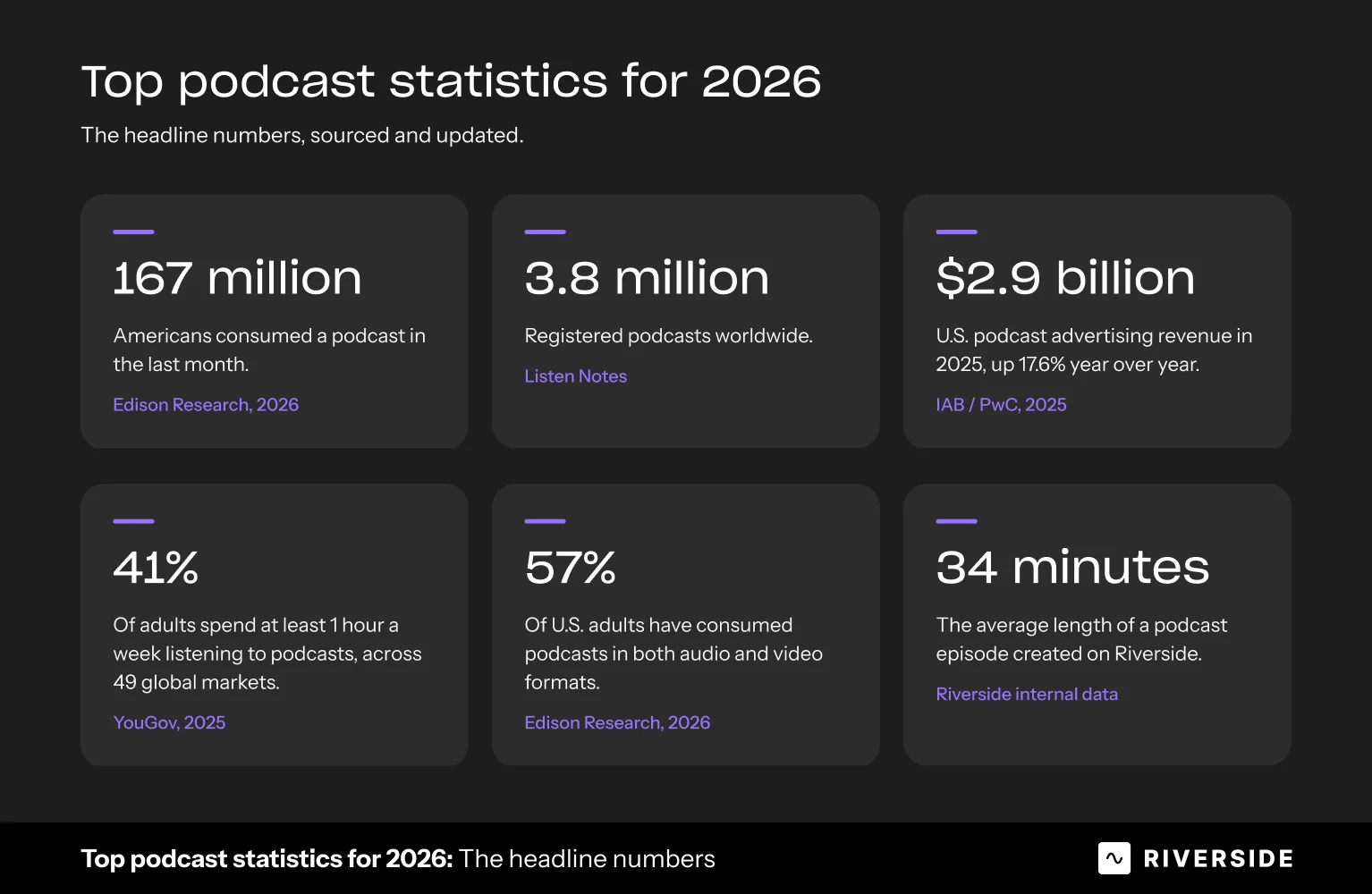
- 167 million: The number of Americans who consumed a podcast in the last month. – Edison [1]
- 3.8 million: The number of registered podcasts worldwide. – Listen Notes [3]
- $2.9 billion: U.S. podcast advertising revenue in 2025, increasing by 17.6% year over year. – IAB/PwC [3]
- 41%: The percentage of adults who spend at least 1 hour per week listening to podcasts across 49 global markets. – YouGov [3]
- 57%: The percentage of U.S. adults who have consumed podcasts in both audio and video formats. – Edison [3]
- 34 minutes: The average length of a podcast episode created on Riverside. – Riverside [6]
Podcast listener demographics
How many people listen to podcasts?
- As of 2026, 80% of Americans aged 12+ have watched or listened to a podcast at least once in their lives, an increase from 73% in 2025. This is an estimated 230 million Americans. – Edison [3]
- Of Americans who had watched a podcast, 58% had watched or listened in the last month and 45% in the past week, an increase of 3% and 5% year over year. – Edison [3]
- Across 49 global markets, 41% of adults listen to podcasts for at least one hour per week. – YouGov [3]
- The amount of time people spend listening to podcasts has increased by 355% in the last 10 years. – Edison [7]
- Podcast engagement is now higher in several emerging markets than in North America. In 2025, 66% of consumers in South Africa, 59% in Indonesia, and 50% in Mexico listened to podcasts for at least 1 hour per week, compared with 38% in the U.S. and 31% in Canada. – Statista [8]
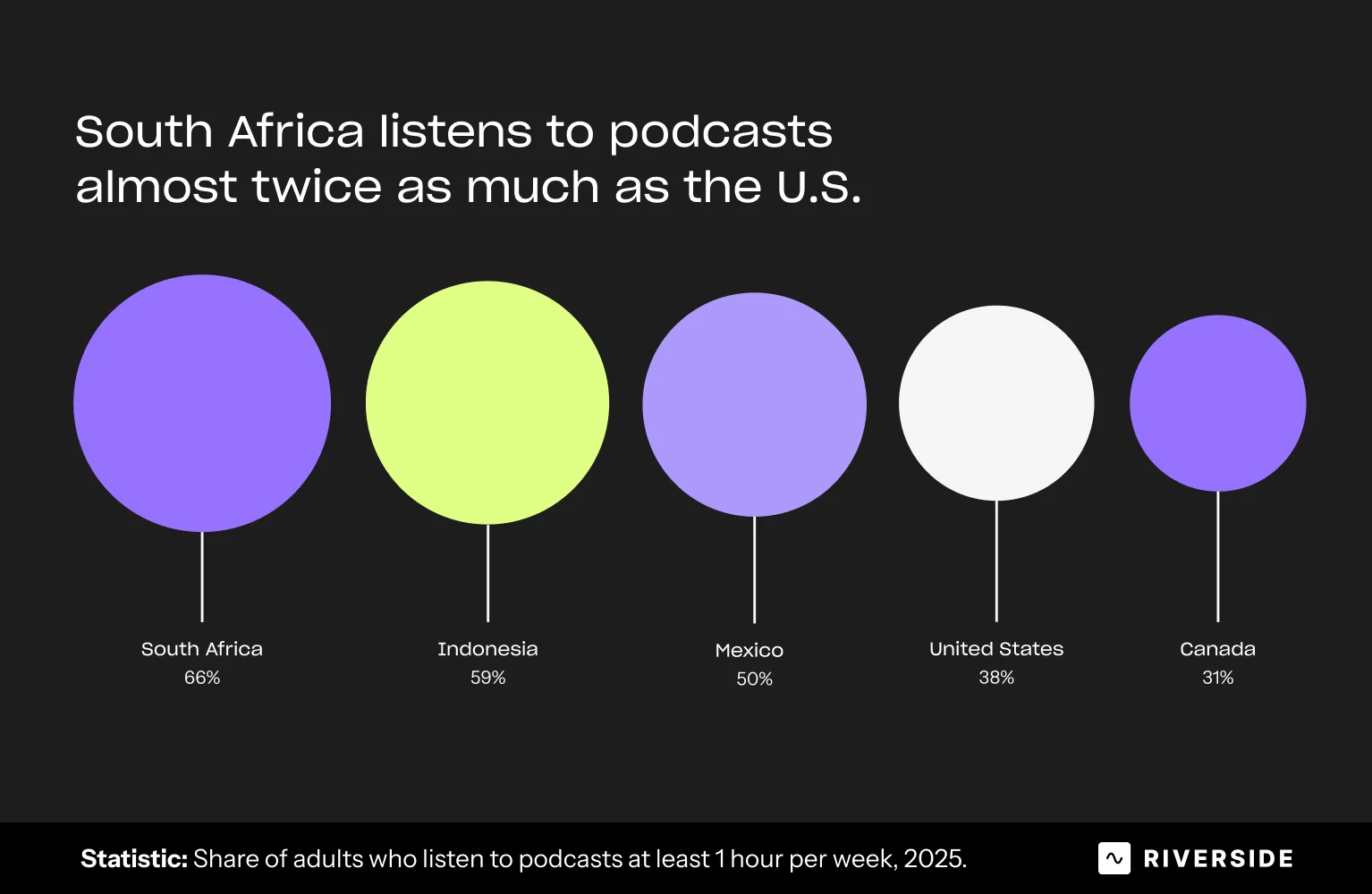
So what? The global listener base is expanding rapidly, and growth isn’t limited to North America. If you want to expand your show, stop limiting your show to local audiences and track where your own audience is growing in emerging international markets.
Who listens to podcasts?
- Millennials and Gen X are the most avid podcast consumers. 64% of U.S. people aged 12-34 and 68% of people 35-54 are monthly podcast listeners. Only 44% of people aged 55+ listen to podcasts monthly, although this percentage saw a 6% increase since 2025. – Edison [1]
- In 2025, 54% of women said they listened to a podcast in the last month, compared to 62% of men. – Edison [1]
- However, among the newcomers who began listening to podcasts in the last year, 60% of them are female. – Cumulus Media [10]
- In 2025, more than half of monthly podcast listeners (51%) had a college degree (compared to 46% of the general U.S. population), and 56% owned a home. – Edison [7]
- 17% of podcast listeners are early adopters of new products. – Statista [9]
So what? Education and employment statistics show that podcasters are a valuable audience for advertisers. Using these stats, you can strategize how to monetize your podcast more effectively.
How often do people listen to podcasts?
- The 45% of Americans who listened to podcasts in the last week listened to an average of 6.4 episodes from 4.3 different shows. – Cumulus Media [10]
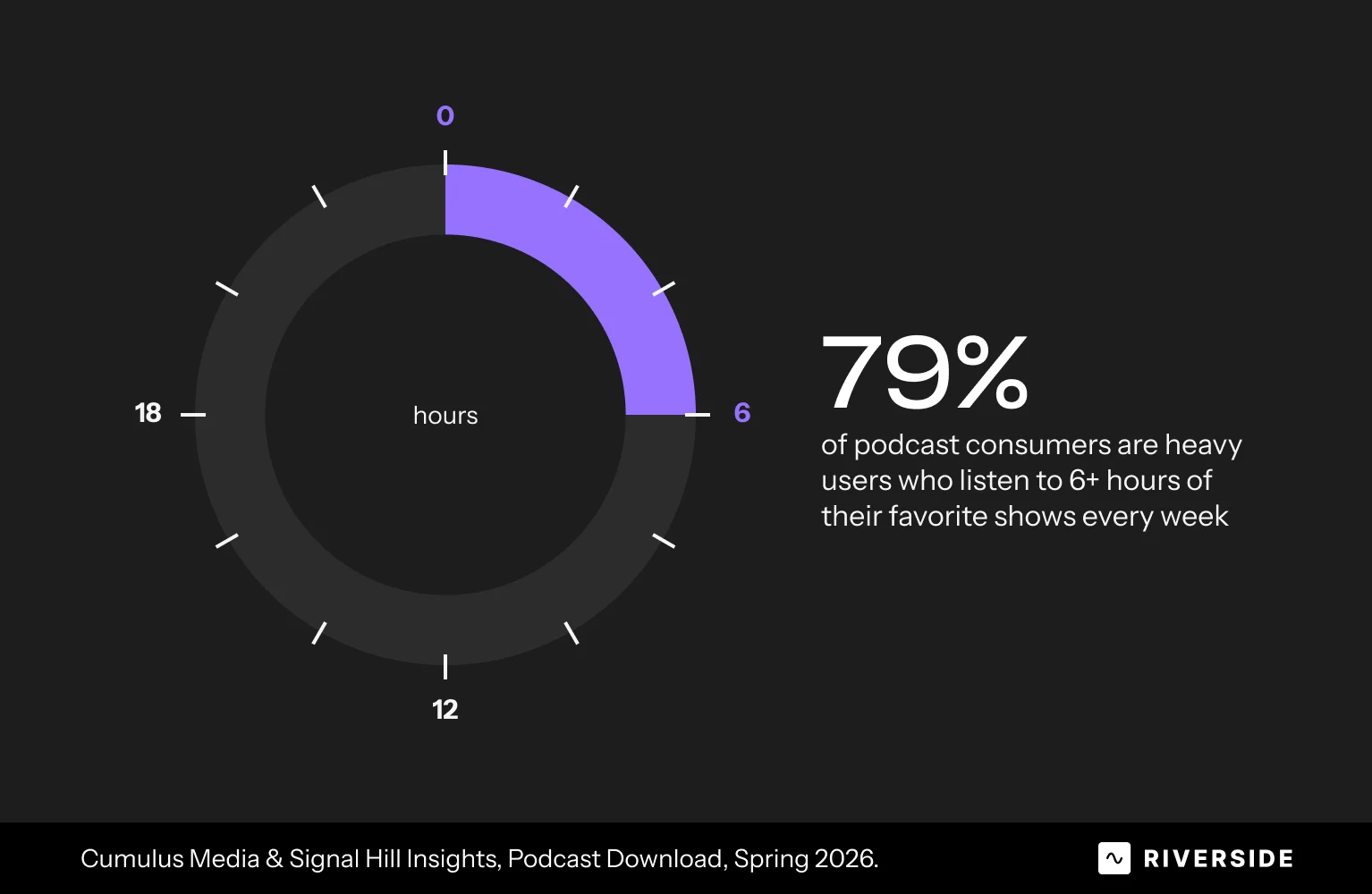
- 79% of podcast consumers are heavy users who listen to 6+ hours of their favorite shows every week. – Cumulus Media [10]
- Listening to audio content like podcasts is the sixth most popular entertainment activity among U.S. adults, right after playing video games. – Marketing Charts [11]
- 82% of podcast listeners will consume a newly published episode within a day, and 59% of them will go back and listen to older episodes once they like a show. – Cumulus Media [10]
- Podcast lovers are a highly engaged audience. 88% of consumers listen to all or most of each episode. Even when they don’t, 78% listen to more than half of the podcast episodes they download. – RAJAR [12]
So what? Aim to reach those “super listeners” who consume many hours of podcasts per week. These are the listeners with the potential to become a loyal fan base. Cross-promote your show on podcasts similar to yours and access new listeners who share your interests.
Where do most people listen to podcasts?
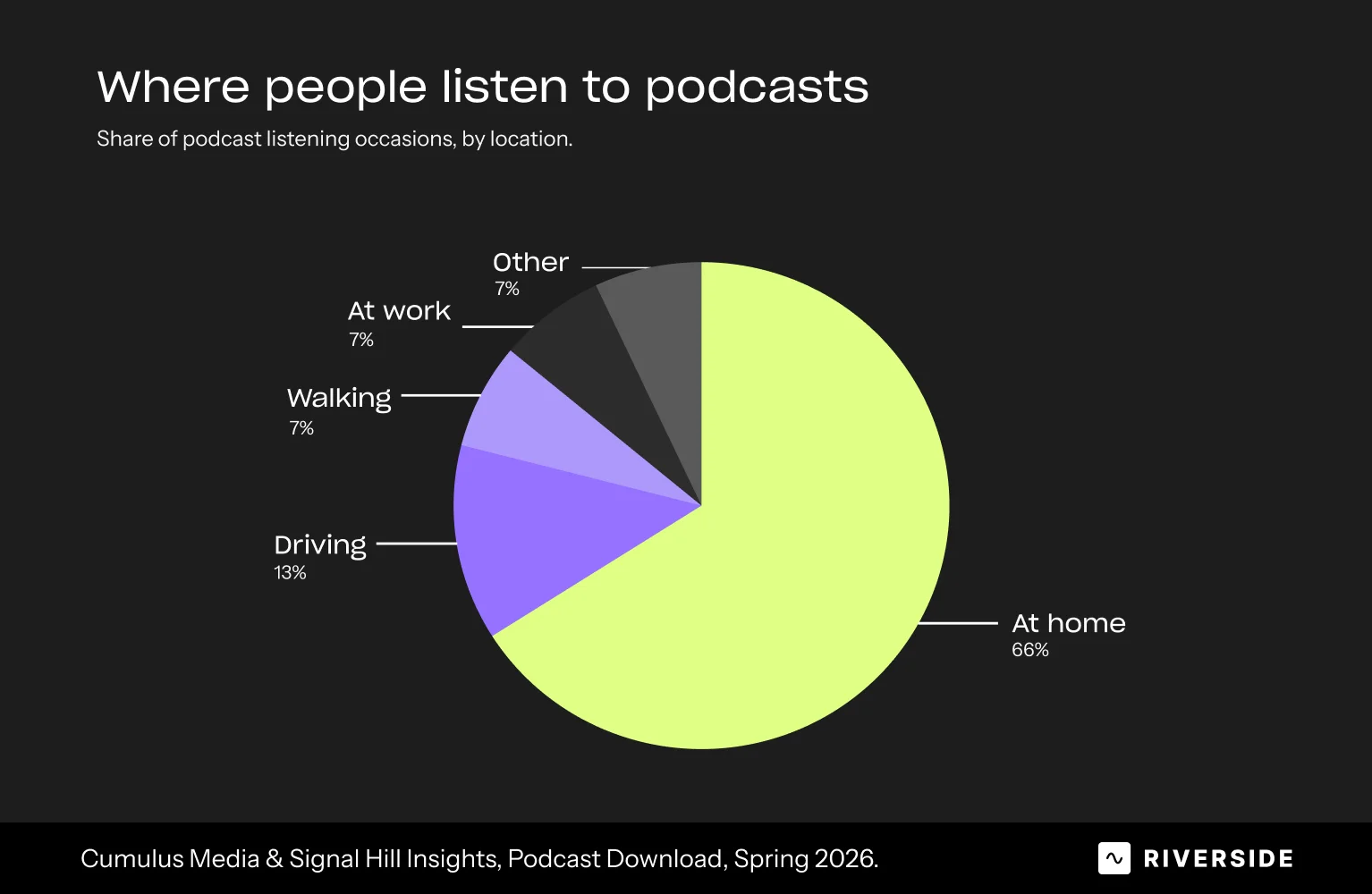
- Podcasts are most often listened to at home (66%), with only a minority of consumers listening to them while driving (13%), walking (7%), or at work (7%). – Edison [1]
- The vast majority of people (87%) prefer to enjoy their shows alone rather than with other people. – Cumulus Media [10]
- Avid podcast listeners also love consuming music. 74% of them say that listening to music is their favorite past-time, followed by video streaming (69%) and traveling for fun (57%). – Edison [1]
So what? Podcast listeners love relaxing when they consume their podcasts. These numbers can also help you target your podcast ads to what your audience is doing when listening.
How do people listen to podcasts?
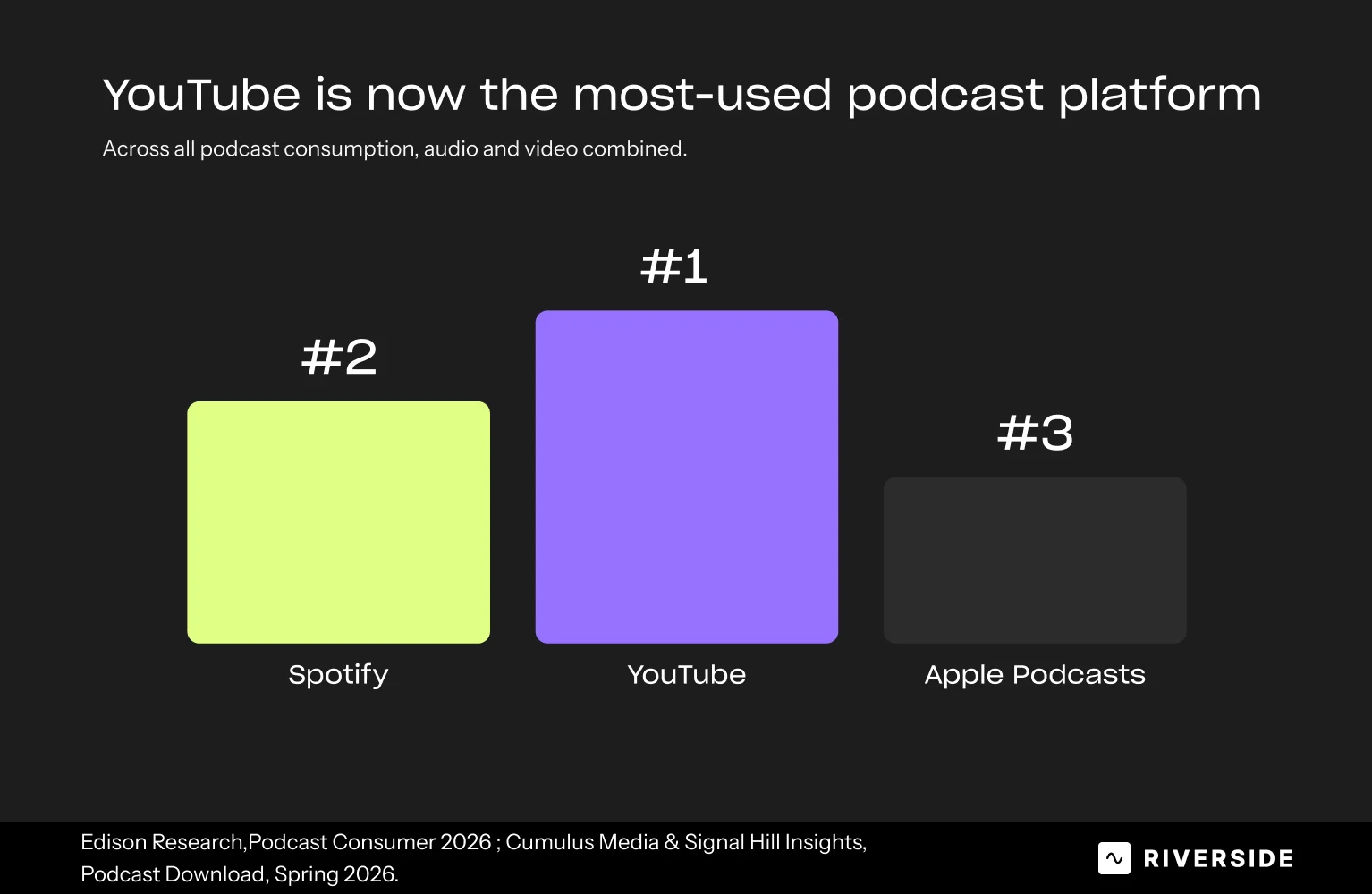
- For all types of podcasts (both audio and video), YouTube is now the most-used platform for podcast consumption, with 40% of listeners, followed by Spotify (24%) and Apple Podcasts (12%). – Edison, Cumulus Media [1, 10]
- As of July 2026, Apple Podcasts (39% of listeners) and Spotify (28%) are the top platforms for listening to audio-only podcasts. – Buzzsprout [14]
- The main reason why people consume podcasts outside of YouTube is because, at that moment, they can only listen (73%). – Cumulus Media [10]
- Smart TVs are becoming a key device to consume podcasts. In 2026, 38% of weekly U.S. podcast consumers used a smart TV to consume podcasts, up from 32% in 2025. – Cumulus Media [10]
- Netflix is the most popular streaming platform among podcast consumers, with 78% saying they use it to watch or listen to podcasts. Amazon Prime Video is the second favorite with 72%, and Tubi nearly doubled in 3 years, jumping from 35% in 2023 to 62% in 2026. – Cumulus Media [10]
So what? Your show must be discoverable on the top podcast directories like YouTube, Spotify, and Apple Podcasts. It’s also essential to optimize your content: If you’re going for a video podcast, make sure it looks good on smart TVs and large computer screens.
Where do people find podcasts?
- Being discoverable is extremely important since looking for new podcasts is a habit. 50% of podcast users look for a new podcast every month. – Sounds Profitable [15]
- YouTube is the #1 discovery engine for finding new podcasts to listen to. 47% of weekly podcast consumers start listening to new podcasts on YouTube, while Spotify accounts for just 16% and Apple Podcasts for 5%. – Cumulus Media [10]
- Not so many podcast listeners find new podcasts through their podcast listening app these days (19%). Most podcast consumers find their next podcast on YouTube (55%), Facebook (30%), Instagram (26%), and TikTok (26%). – Sounds Profitable [15]
- Creators acknowledged the importance of YouTube as well. 88% of podcast-intent Riverside users who repurpose clips include YouTube in their distribution, far ahead of Instagram (23%) and TikTok (14%) – Riverside [6]
- Organic social posts appear to drive more podcast discovery than paid promotion. Among listeners who found their favorite podcast through social media, 60% discovered it through a post from someone they follow, compared with 33% through a sponsored post or ad. – Sounds Profitable [15]
- Most people say they stop listening to podcasts because they don’t have enough free time (41%). However, 16% say they do because they can’t find a podcast they want to listen to. In other words, discoverability can be an issue. – Sounds Profitable [16]
- The top RSS hosting domain is anchor.fm, accounting for 55% of total podcasts, followed by buzzsprout.com with just 7% of them. – Listen Notes [3]
So what? Discoverability and building an audience are among the biggest challenges podcasters face, so use these statistics to reach new listeners by:
- Pushing your show up the in-app charts by encouraging your listeners to subscribe to your podcast and recommend it to friends.
- Sharing your podcast on your social media accounts and working with relevant influencers to promote your show to their audiences.
- Working with other podcasters to promote each others’ shows.
- Working on your podcast SEO to increase your discoverability on YouTube and search engines.
Why do people listen to podcasts?
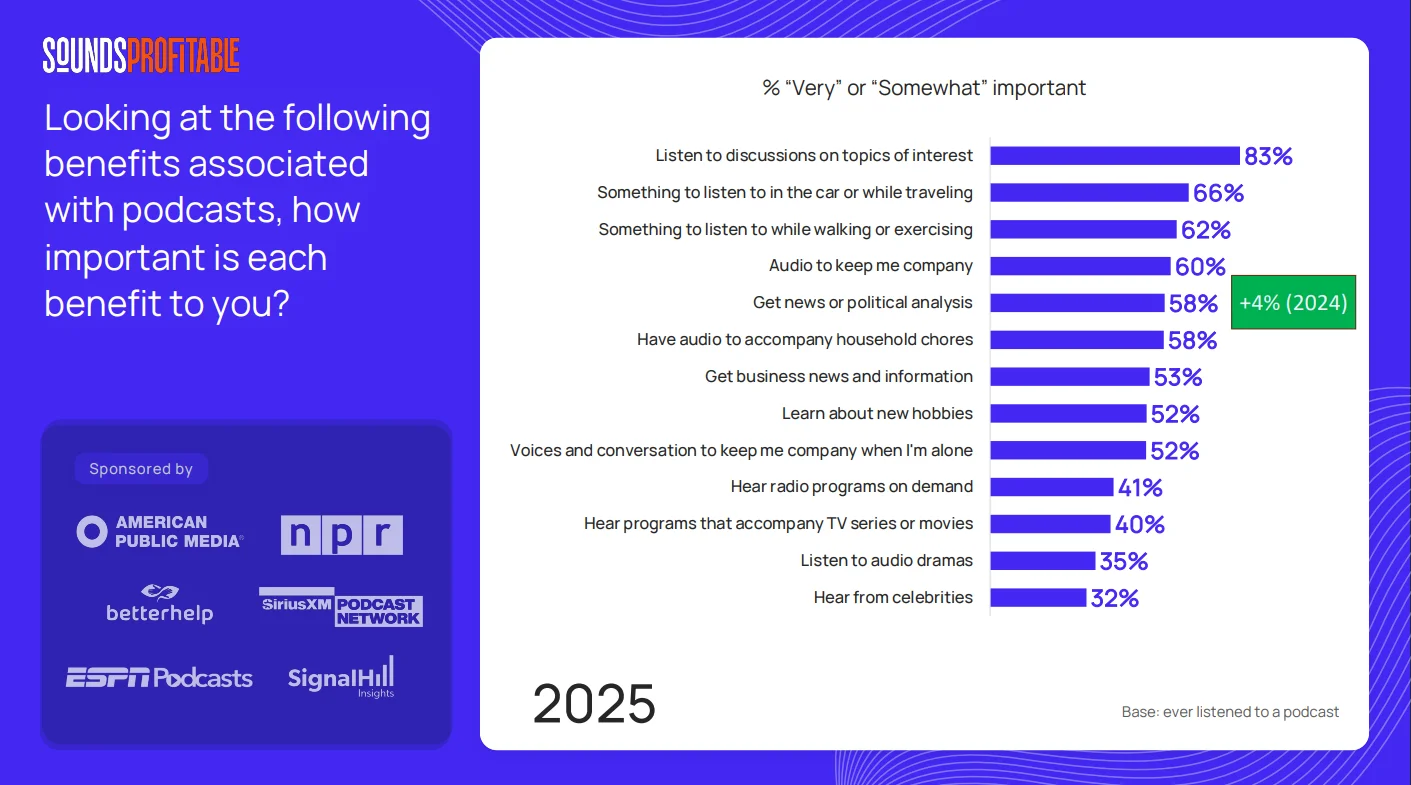
- People listen to podcasts because they want to hear discussions on topics of interest (83%), want to have something to listen to in the car or while traveling (66%), or want to listen while walking and exercising (62%). – Sounds Profitable [17]
- 84% of young podcast listeners tune in to dig deeper into topics of interest; 74% listen to hear unique perspectives on topics not covered in other media. – Edison [18]
- People trust what podcasts say. Content on podcasts is described as factual and accurate by 51% of listeners and is used as a source of news by 39% of people aged 18 to 49 years. – Sounds Profitable, Statista [19, 20]
- Consistency is key. 76% of U.S. podcast consumers listen to shows that publish new episodes on a regular schedule. – Sounds Profitable [17]
So what? Understanding how and why people listen to podcasts can help you better understand how to engage your audience. For example, if 62% of a podcast’s listeners are exercising while listening, this provides some insight into the advertisers that may appeal to them.
General podcast statistics
How many podcasts are there?
- There are 3,789,257 podcasts out there. These are real podcasts generated by humans with at least 1 episode. – Listen Notes [3]
- Sadly, the proliferation of junk or low-quality AI shows has become an issue. As of July 2026, Listen Notes had removed more than 35,600 shows since the beginning of the year. – Listen Notes [3]
- 85,913 new shows are launched every 3 days. That's an average of 28,638 new shows every day. – Podcast Index [21]
- While Spotify claims to have nearly 7 million podcast titles on its roster, Apple Podcasts only lists 3,094,137 valid podcasts. These numbers likely include many inactive shows. – Spotify, Apple Podcasts [22, 23]
- The United States produces the vast majority of podcasts, accounting for 65% of all shows. Brazil ranks a distant second, with just 5.6%. – Listen Notes [3]
- The year with the highest growth of new podcasts was 2020, with a sharp decline from 2022 on. – Listen Notes [3]
The future of podcasting: Is the podcast industry growing?
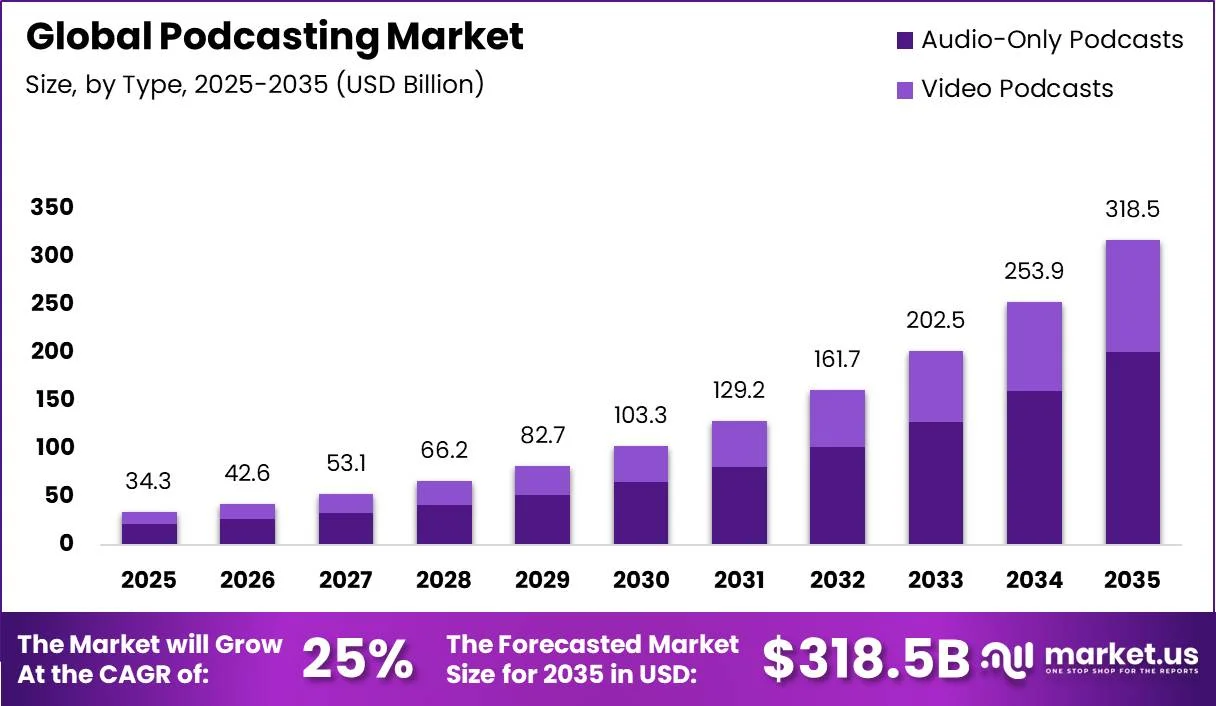
- As of 2026, the podcast industry continues to grow. The global podcast market is currently worth $6.21 billion and estimated to increase to $50.04 billion by 2034. – Fortune Business Insights [24]
- North America dominates the podcasting market with a 34.2% share that generates $11.7 billion in revenue. – Market.us [30]
- The global podcast advertising market is projected to reach 771 million users by 2030. – Statista [13]
- Podcasts generated $2.9 billion in ad revenue in 2025. This is only 1% of all digital ad spend, but the market is growing rapidly, with a 17.6% year-over-year increase. – IAB/PwC [3]
So what? If there’s a time to get involved in the podcast industry, it’s now. But there’s still a lot of competition. Make your podcast stand out by defining your unique selling point (USP), targeting an ideal listener persona, and implementing clever podcast marketing based on the statistics in this article.
How many downloads does the average podcast have?
- If your podcast episodes get around 25-30 downloads in the first week after release, you’re already in the top 50% of podcasters. – Buzzsprout [14]
- To reach the top 10% of worldwide podcasters, you need at least 412 episode downloads in the first week after release. – Buzzsprout [14]
So what? Include a CTA in your podcast intro to make it clear how listeners can subscribe to your show. Ramp up your marketing campaign on social media, websites, and other relevant podcasts to reach a wider audience.
What is the most popular podcast publisher?
- The most popular podcast publisher in the U.S. is the iHeart Audience Network, with 55,148,000 unique monthly listeners, followed by the NPR Sales Network (17,034,000) and Libsyn (12,846,000). – Podtrac [25]
What are the most popular podcast genres and formats?
- The most popular podcast genres are comedy, true crime, politics, and entertainment/celebrity/gossip. – Edison [1]
- Some smaller genres appear particularly effective at attracting new listeners. Among people who had started listening to podcasts within the previous year, 45% were consuming kids and family podcasts, and 43% education shows. – Triton Digital [26]
- No single genre or format is currently dominating the podcast ecosystem. The top U.S. podcasts for the first quarter of 2026 included a mix of conversational shows, true crime, news, interviews, educational content, and sports. – Edison [1]
So what? Listen to some of the most popular podcasts in your genre and take note of their format, length, and content. You can also listen and take tips from the top podcasts in the world:
- Comedy: The Joe Rogan Experience, This Past Weekend w/ Theo Von, Smartless, Call Her Daddy
- News: The Daily
- True crime: Crime Junkie, Dateline NBC, MrBallen Podcast
- Sports: New Heights with Jason & Travis Kelce
- Education: Stuff You Should Know
Video podcast statistics
How many podcasts use video?
- The majority (72%) of podcast episodes published by Riverside creators now include video. Only 28% of them are audio-only. – Riverside [6]
- More and more podcast consumers now like to watch videos as they listen to audio. Audio-first consumption of podcasts has fallen from 71% in 2022 to 51% in 2026. – Cumulus Media [10]
- Podcast newcomers are most likely to prefer watching podcast videos. But those who only watch without listening to audio are just 8% of the weekly podcast audience. – Cumulus Media [10]
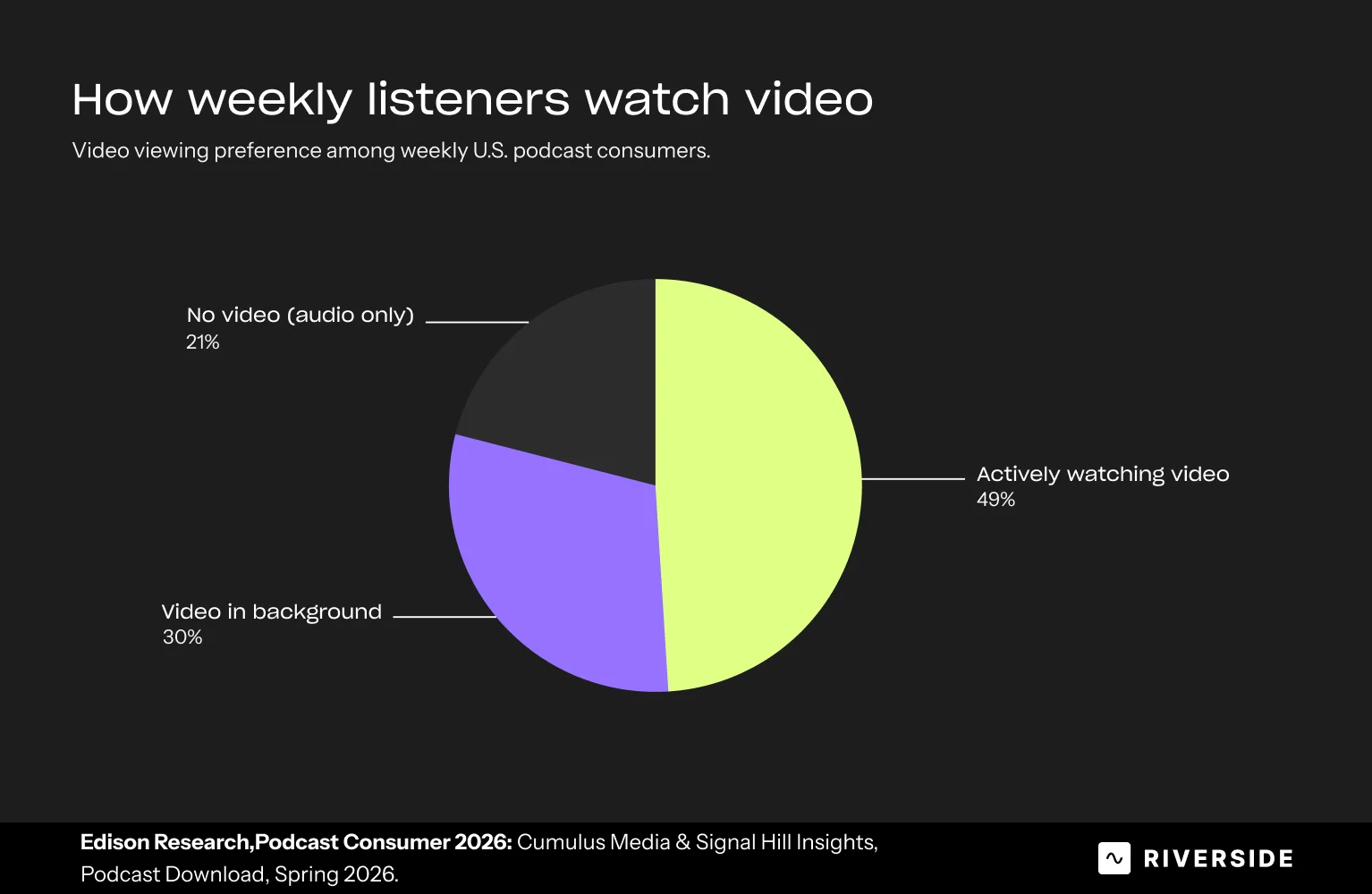
- 49% of weekly U.S. podcast consumers prefer actively watching podcast video, while 30% prefer playing the video in the background or minimizing it. Only 21% prefer podcasts without any video. – Cumulus Media [10]
- In 2025, 50.6% of shows were posting full videos on YouTube. This is 130% more than in 2022. – PodNews [27]
- Video podcast consumers are generally younger. 30% of Gen Z mostly listens to video podcasts; 7% only listen to video. – Coleman Insights [28]
- Among podcast listeners who choose video, 71% say it’s a more engaging or richer experience, and 61% point to facial expressions and body language as the reason. – YouGov [29]
So what? Video podcasting is not yet the norm, but as YouTube becomes the most used podcasting platform, the growth potential of video podcasts is clear. This means that video podcasting is a great way for your show to stand out from the competition.
Good news: Using software like Riverside makes it really simple to record and edit studio-quality podcasts.
Podcast production statistics
What software do podcasters use?
- Podcast creators using Riverside vastly prefer to record directly in production software rather than upload existing content. Live studio recording is 3.3 times more common than uploading a pre-recorded file. – Riverside [6]
- Recording software is no longer used just for capturing audio and video. 66% of podcast-intent Riverside users who start a recording export at least one repurposed clip within 30 days. – Riverside [6]
- The tools podcasters most commonly pay for are podcast hosting (48%), website and domain (41%), editing and production tools (31%), and AI tools (27%). – RSS.com [31]
- 40% of podcasters use AI-powered software to produce and promote their shows. – Market.us [32]
- Software makes up the largest share of the AI in the podcasting market, accounting for more than 60% of the total. – Market.us [32]
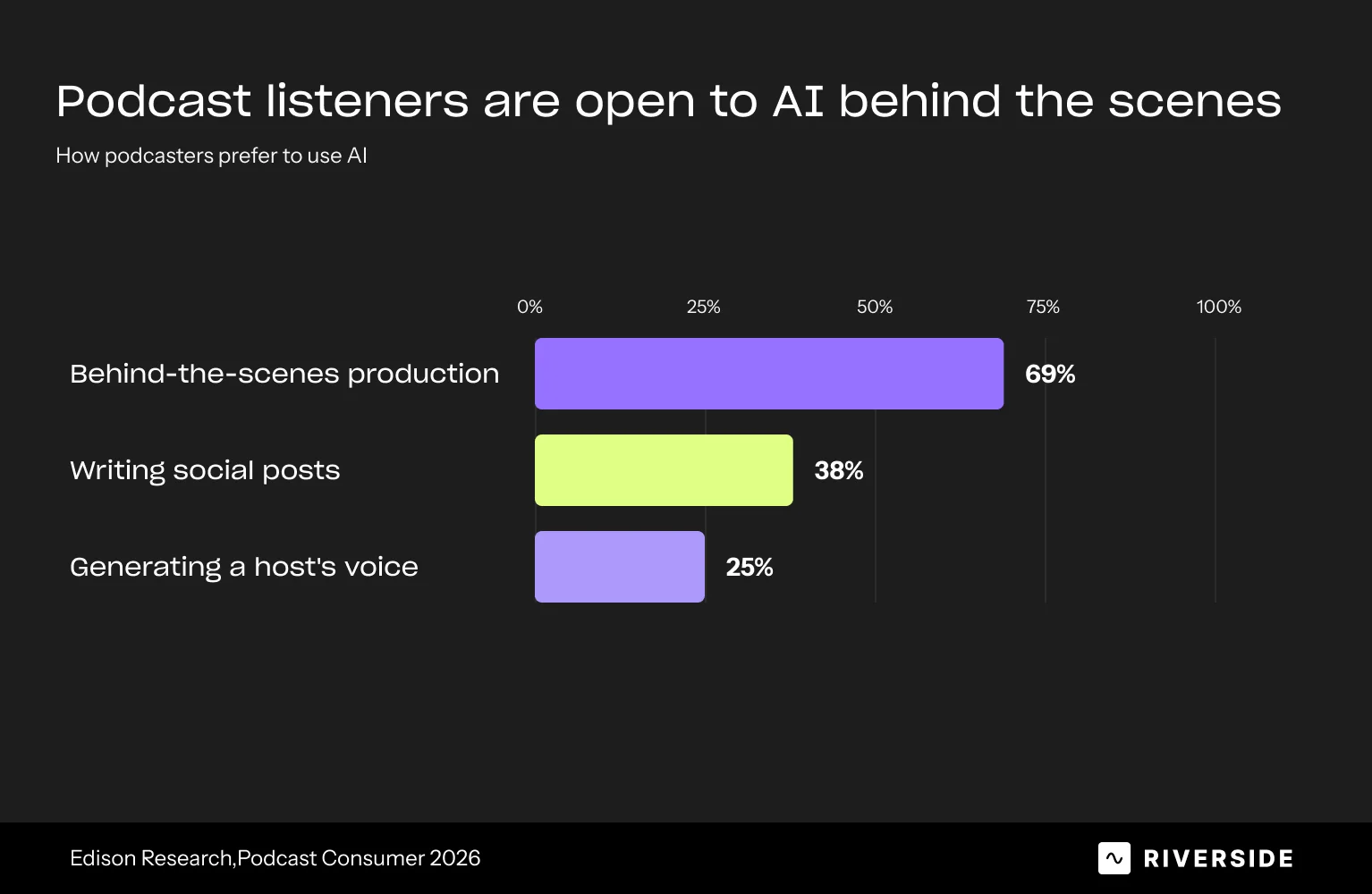
- Beware though: Podcast consumers have mixed opinions on generative AI. Most listeners (69%) approve of using it to handle behind-the-scenes production like conducting research or brainstorming ideas. However, very few approve of using it to generate a host's voice (25%) or write social posts (38%). Many perceive it as a threat to a podcast’s credibility (62%) or creative process (59%). – Edison [1]
So what? Platforms like Riverside use AI to make recording, editing, and repurposing a podcast easier with tools like AI transcription, instant audio editing, and automatically generated clips. But what Riverside's AI won't do, is replace your creativity, your perspective, or your personality!
What equipment do podcasters use?
- Many podcast hosts prioritize pristine audio quality when producing their shows. Based on hardware-selection data from Riverside, 49.8% of podcast hosts record with an external microphone instead of their laptop, earphone or phone built-in mics. – Riverside [6]
- Most creators don’t view external cameras as a critical upgrade. Only 38.7% of podcasters use an external camera for their show, while 52.8% still rely on their device’s built-in camera.– Riverside [6]
- A small share of 8.4% of podcast hosts use their phone as a webcam. – Riverside [6]
- The leading brands for podcasting microphones are Shure, Logitech for Creators, MAONO, FIFINE, and HyperX. – VMR [34]
- The Blue Yeti is consistently the most popular podcasting microphone overall, having held its top position since 2019. It’s used by 16.6% of podcast users, followed by the Samson Q2U (8.1%) and the Shure MV7 (6.3%). – The Podcast Host [35]
- Experienced podcasters who hosted their shows for more than 5 years, however, prefer the Shure MV7 (13.2%), Shure SM7B (9.6%), and Shure SM58 (9.6%). – The Podcast Host [35]
- 70% of podcasters use headphones when recording and in post-production. That means 30% of people may be missing audio problems happening during recording. – VMR [34]
- The global podcasting hardware market is expected to grow by 22.8% per year, reaching $28.07 billion by 2034. – Market.us [33]
- Microphones are the largest hardware category, making up 24.2% of the market. – Market.us [33]
- The most frequently used podcast accessories are boom arms (36%) and pop filters (31%). – The Podcast Host [35]
So what? There’s so much different equipment out there, and its popularity changes year on year (except for the Blue Yeti, which is a keeper). Check out our best podcast equipment guide to find the right kit for you and your budget.
Average podcast length
- The sweet spot for podcasts is 20-40 minutes. The median finished, edited Riverside podcast episode runs about 34 minutes. The average is slightly longer at 37 minutes. – Riverside [6]
- Half of all measured Riverside episodes run between 16 and 53 minutes. So, if you feel an interview needs more time, don’t cut it short and just keep recording. – Riverside [6]
- The average episode length of the top 50 podcasts in the U.S. is 165 minutes. However, many episodes last from under 10 minutes to over 2 hours. – Ausha x Edison [36]
So what? Study the podcast structure and length of podcasts in your niche to figure out what might work best for you. Keep things tight to keep people listening, but don’t feel forced to cut longer episodes just to meet an arbitrary target. Just make sure to hook your listeners right at the start of each episode.
Average podcast frequency and schedule
- On Riverside, the median active podcaster published 4 episodes in the last 90 days, roughly one every three weeks. – Riverside [6]
- 34% of podcasts publish an episode on their hosting platform every 3 to 7 days, and 37% publish every 8 to 14 days. – Buzzsprout [14]
- Only 41.5% of podcasts make it past 8 episodes and only 8.7% of podcasts make it past 50 episodes. – Podmatch [37]
- Podcast consumers prefer shows that publish with a consistent schedule. 79% of them listen to a show that publishes new episodes regularly, compared to just 54% who listen to shows that release episodes occasionally. – Sounds Profitable [17]
So what? Learning how to schedule your podcast will help you produce regular, engaging content that will keep your listeners interested. And if you make it past 10 episodes, congrats: You’re already in an elite class of podcasters.
How long does it take to launch a podcast?
- On average, it takes about 14 days between someone's first recording and their first published podcast episode. – Riverside [6]
Most popular posting times
- The most popular days and times Riverside podcasters publish their shows are Tuesdays and Wednesday, roughly between 4 and 7pm ET. – Riverside [6]
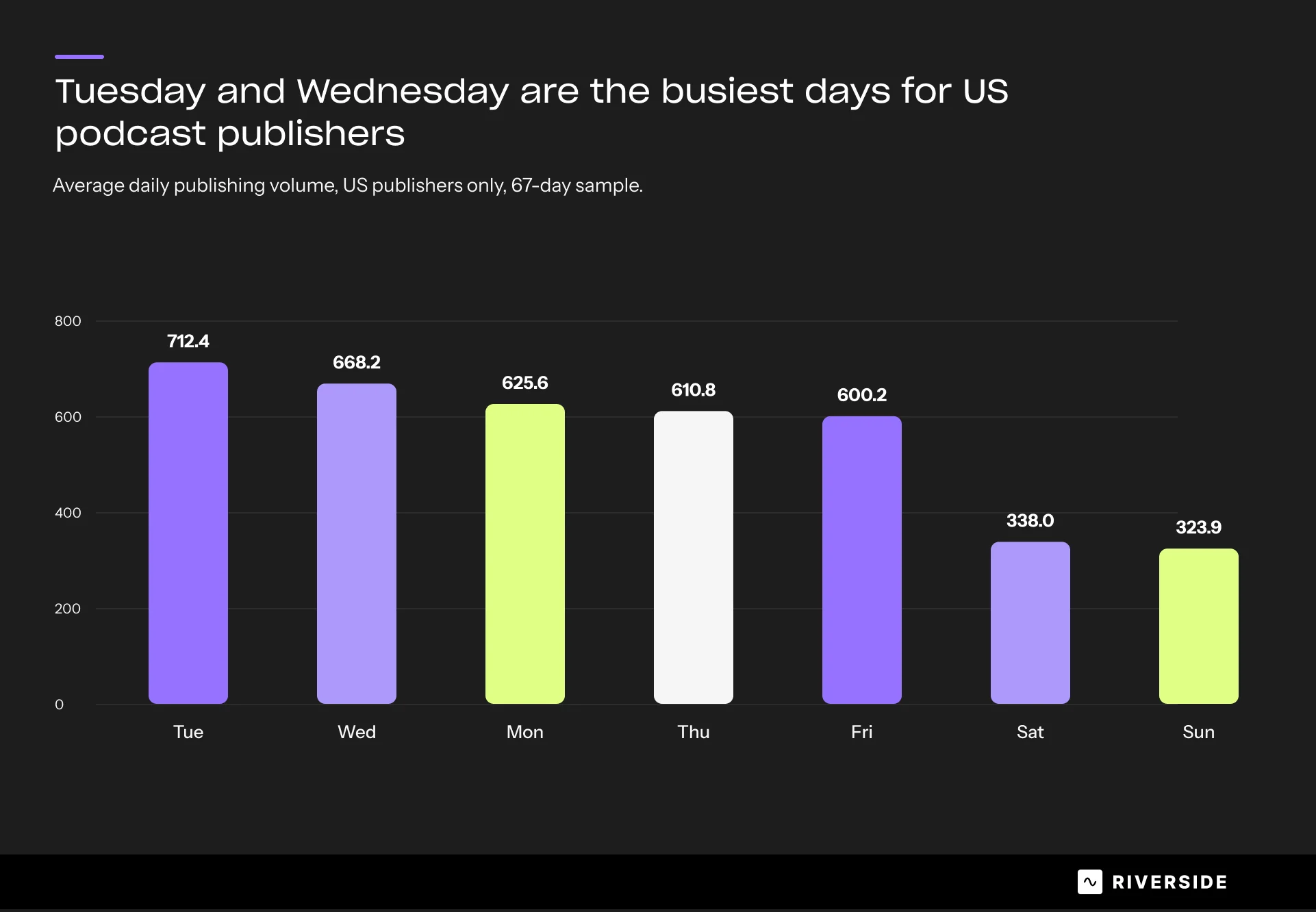
Note: We narrowed time to US-based creators, the single largest group at roughly half of all episodes, and converted the results to US Eastern time.
So what? You want to publish your content when your audience is active. Looking at popular publishing times can help, but we suggest analyzing your target audience more closely. When are they most active online? It won't help to publish a podcast at an ideal EST time when you and your listeners may be in another time zone.
Podcast monetization statistics
How do podcasters monetize their shows?
- Three-quarters (76%) of weekly podcast listeners have purchased a product or service after hearing an ad on a podcast. – Edison [1]
- 39% of podcast listeners trust podcast hosts delivering an advertising message. – Sounds Profitable [19]
- This translates to very good conversion rates for podcast ads. 9.7% of listeners who visited an advertiser site coming from a podcast ad convert to leads, and 5.2% will complete a purchase. – Magellan AI [38]
- 21% of weekly listeners paid money to support their favored podcast in the last 12 months. – Edison [1]
- In 2025, the most common ad position in the U.S. is mid-roll (49%). – Magellan AI [39]
- The priority for most podcasters is reaching new audiences. The main goal of podcast ad spending in the U.S. was brand awareness (63%) followed by direct response (35%). – Magellan AI [39]
So what? Use the podcast statistics above and our guide to monetizing your podcast to target your ads and sponsorships to your listener profile.
FAQs on Podcast Statistics
How do I find podcast stats?
You can find podcast stats by looking at public industry reports, podcast charts, or your own hosting platform's analytics dashboard.
For industry-wide statistics, you can check this page as we update it regularly, or go to Buzzsprout for download and publishing benchmarks. You can also use Spotify for Creators, Apple Podcasts Connect, and YouTube Studio for platform-specific data on listeners, viewing time, demographics, and engagement.
How can I see how many listeners a podcast has?
If you’re looking for how many listeners your podcast has, check your hosting platform’s podcast analytics.
If you’re interested in finding out how many listeners another podcast has, this might be a little trickier because this information is usually private. It also depends on what you classify as a listener. Is this someone who’s subscribed, or someone who’s just listened to only one episode?
You can look at things like social media followings, site traffic, ratings, and reviews to get an idea of a podcast's popularity.
How many podcasts are there in 2026?
There are about 3.79 million publicly available podcasts in 2026, according to Listen Notes.
However, this does not mean that all 3.79 million shows are still active. Directories like Spotify claim to host nearly 7 million podcast titles, but many of those are duplicate or inactive feeds. Apple Podcasts lists roughly 3.1 million valid, active shows.
Are podcasts still growing in 2026?
Yes, podcasts are still growing in 2026. Around 58% of Americans aged 12 and older consumed a podcast in the past month, up from 55% in 2025. This represents an estimated 167 million monthly U.S. podcast consumers. U.S. podcast advertising revenue also reached $2.9 billion, demonstrating a strong 17.6% year-over-year growth rate.
Sources
- Edison Podcast Consumer 2026
- Listen Notes Podcast Stats
- IAB/PwC Internet Advertising Revenue Report: Full Year 2025
- YouGov Global Podcast Listeners in 2025
- Edison Infinite Dial 2026
- Riverside internal research data
- Edison Podcast Consumer 2025
- Statista — People who listened to 1 hour of podcasts per week 2025
- Statista — Target audience: Podcast listeners in the US (2026)
- Cumulus Media And Signal Hill Insights’ Podcast Download 2026
- These Are Americans’ Most Common Entertainment Activities
- RAJAR’s Audio Survey ‘MIDAS’ Autumn 2025
- Statista — Podcast Advertising Worldwide
- Buzzsprout Podcast Stats
- Sounds Profitable’s Podcast Discovery Playbook 2026
- Sounds Profitable’s The Podcast Landscape 2024
- Sounds Profitable’s The Podcast Landscape 2025
- Edison Podcast Consumer 2024
- Sounds Profitable’s The Advertising Landscape 2025
- Statista — Usage of podcasts as a news source in the US 2020-25
- The Podcast Index
- About Spotify Company Info
- Apple Podcasts Statistics
- Podcasting Market Size, , 2026-2034
- Podtrac — Top US Publishers and Networks
- Triton Digital U.S. Podcast Report
- The biggest podcast app in the US for consumption - 2025
- Coleman Insights — The State of Video Podcasting
- YouGov Are podcasts going visual?
- Market.us Podcasting Market 2026
- RSS.com Podcaster Insights Survey
- Market.us AI in Podcasting Market
- Market.us Podcasting Hardware Market
- VMR Podcasting Microphone Market
- The Podcast Host — Podcasters Gears and Setups in 2024
- Ausha x Edison Research: Most Successful US Podcasts
- Podmatch Podcasting Industry Report
- Magellan AI — Podcast Measurement Benchmark Report Q1 2026
- Magellan AI — Podcast advertising market trends: H1 2026
Riverside data methodology: How we built our statistics
Riverside statistics come from our own product data, not surveys or third-party estimates. They reflect actual user behavior on our site.
Our sample
With over 1 million all-time creators who’ve used our platform for podcasting, webinars, video marketing, and more, we needed a way to define a podcast-only sample. We narrowed it down to a sample of 11,257 podcasters, only including users who published a podcast episode through our hosting in the past 90 days:
- Publishing an episode means setting up a show, adding an episode with a title and description, and sending it to a feed. This is something you can only do inside Riverside's podcast features, not when hosting a webinar or general recording.
How we measured each statistic
This is what we looked at for each individual statistic listed above:
- Video vs. audio-only episodes. Every published episode is tagged as either audio-only or audio-and-video. We counted all episodes in the period and compared the two.
- Live recording vs. uploading. Episodes are also tagged by origin: recorded in Riverside's studio, or uploaded as an existing file. We compared the volume of each.
- Clip exporting. We looked at creators who published an episode, then checked how many exported at least one short-form clip within the following 30 days.
- Where clips get shared. For creators who published clips through Riverside's social publishing tool, we counted which platforms they published to. Creators often post to more than one, so these percentages don't add up to 100%.
- Microphones and cameras: We looked at the equipment creators selected before recording, counting only the host, and only where that recording session led to a published episode. (We did not include guests, who often join with whatever's already on their laptop). Equipment was identified from the device name a user's browser reports.
- Publishing day and time. We counted published episodes by hour across a 67-day period, grouped them by day of week and hour of day, then converted to US Eastern.


.webp)

.webp)