Live workshop: Audience growth and monetization
Grow your audience with podcast SEO, a unique selling point and branding that turns searchers into listeners.

Grow your audience with podcast SEO, a unique selling point and branding that turns searchers into listeners.
In this live workshop, marketer Ross Simmonds explains why every webinar should become a library of content, and Riverside shows the tools that make repurposing faster.
The video covers:
00:00 Hello to everyone who is tuning in live or watching the recording. My name is Kendall Breitman and I am the community lead here at Riverside. And we in this community have started a series and it's called our community workshops. And we've had a few of them in the past. So oh for some of you, this might be, you might be a few community workshops in, but we are, we basically set up this program so that people in our community can share their skills and their knowledge with each other.
00:28 And so you can learn from your peers about things that are important to all of you. So one thing that I hear about a lot is that growing your listenership, growing your audience is a constant struggle. It's something that everyone is trying to understand how to do more of. And it is something that I definitely hear of probably the most out of anything that I hear from people of what they're trying to learn.
00:51 So this is what brought us to this session because we are going to be talking about how to get more listeners. And I couldn't think of better people to talk to about getting more listeners than the two people behind getmorelisteners.com. well, I am really excited to have you both joining me today. We have Anthony and Tiag here from the community.
01:15 And we're gonna be going through their method on how to grow your listenership, grow your audience. And the whole point of these workshops is to be able to take actionable steps that you can take right after this workshop and apply towards your own podcast, channel, whatever you're creating. So this session is recorded. you can feel free to put out your notebooks, take out those notebooks and take them out and write something down.
01:40 But this will also be recorded. So feel free also to just focus on what we're talking about now and you will get all of those notes later on. So in the chat. You could tell us a little bit more about your podcast, about your channel, because I'd love to just hear more about what you're working on so that it could also help us give you better tips on how to grow your listenership.
02:02 And as you do that, I'm gonna let these two take it away and introduce themselves. So yeah, thank you both so much for joining me. Absolutely Kendall what what introduction that was awesome I felt like I was in a and a proper real real show says that it's good to be here Kendall and it's awesome to Have so many people joining us as well. I've seen the chat going off. We've got Kate Keith Nicola John hope everyone's doing good.
02:31 It's like how you doing? Done good, ready to jump into it. Shall we dive in, Kendall? Yeah, we could dive right in. As you, actually want to start off in the chat by saying like, What are things that you have tried as far as growing your listenership? Because I'm wondering if like if this is going to if there's going to be stuff that you guys hear all the time about what people are trying to do and maybe not finding as much uh as much um success in or maybe that's aligning with what you're talking about.
03:03 But um yeah, let's share as we're going some things that everyone's doing to grow their listenership. But otherwise, I leave it up to you. Let's get into it because I know we've got a lot to share. Awesome, let's do it. Yeah, I'm looking forward to seeing what people have been up to with growing so far. Let's get into it. Guys, it is an absolute pleasure to be here. This is how to grow and monetize your podcast in 2026, a Riverside exclusive.
03:31 So we haven't done this before. This isn't a presentation we do elsewhere. This is exclusively for you and this is the first time. So in this workshop, you're going to discover the number one mindset shift you need to make around what you do to promote your podcast in order to grow and monetize way faster and easier in 2026. how to differentiate your podcast and a sea of other shows so every bit of exposure actually converts into growth instead of falling flat.
03:59 why you can't afford to ignore podcast SEO and the simple steps to ranking on page one of Apple and Spotify even if you've never heard of podcast SEO before. And finally for every single person here we have a bribe, a potential early Christmas gift for everyone who sticks around until the end. So again you want to stick around to the end of this workshop. There we go.
04:23 So look, before we get into what we just discussed, you might just be wondering who we actually are, what is getting more listeners, who are these two young British guys, and what do they know about growing a podcast? So we'll very quickly catch you up to speed with how we got into this space. So look, me and Tiag came from a small town known as Kingsland. You can probably tell by the thick British accent we are from the UK. And here is a photo of us when we younger trying to look cool.
04:48 Please pardon the cringy pose and the fact that we're clearly underage drinking in this photo. So we started, yeah, there's many more. I this one is not much better. This was us. appreciate you sharing that with the community. It's a beautiful way to start. Good, good. Well, it can only go up from there, right?
05:11 So this is us at the start of our journey in university. And we started our business five years ago as two young, hungry, but incredibly naive college students who wanted to make money online so we could travel the world, have more freedom, and really make an impact. But we had absolutely no idea what we were doing. Then COVID happened.
05:36 So look, at this point, Tiag could already switch from studying maths, again, I'm still clueless as to why he did it in the first place, to music, which was his passion. This is him teaching me in our first year of university. Meanwhile, I was essentially stuck. doing sports science, still clueless what I was doing, feeling totally lost, anxious, and just completely misaligned.
05:58 And one evening, I was pretty down, and I was pretty depressed, to be honest, because again, I knew what I was doing wasn't in alignment with what I wanted to do. I got on my knees, one of those evenings, I prayed, and I just said, God, look, give me some directions. I've got no idea what I'm doing. And that same night, got one of those ads that you probably have seen, do you wanna make money online? Well, that hit me. And of course, in that state, I was like, yes, yes I do. So I went through the funnel, I was completely sold, and then the next morning I was super excited, ranked high straight away.
06:30 I was like, dude, you gotta watch this. He watched it, he was sold as well. And then we made our very first investment, split $1,000 into this program. And the business model behind this course that we invested in was simple. Find a low competition niche on Amazon, write and publish a high quality book about it, get reviews on the book and quote unquote print money, right?
06:54 That was the plan. And we chose podcasting. Now we decided podcasting honestly, it was like some genius master plan. was part luck and part research. As a lot of you all know, podcasting around 2020, it just blew up. So thankfully the timing worked out and we decided to go into this niche. And I remember at this point, I was at a point where I was dedicated, I wanted to make this work.
07:19 So I eventually dropped out of university in my final year to actually pursue building the business and serving podcasters who are now our new found audience. Long story short, our first book completely failed. And if by any chance anyone here has seen this book on the internet, then just know that you've seen a relic, a real antique. So this was our first book. It didn't do very well at all. And if you're wondering, by the way, yes, Daniel Larson is us.
07:46 So we used a pen name because, well, I mean, to be honest, Tiag O'Shea Anthony Nwaneri I think Daniel Larson rolls off the tongue a little bit easier. And also we just didn't have the forward planning. We didn't know. how long we're gonna be in this space. We just didn't really plan ahead and it ended up being very confusing. But anyway, our first book failed, but we also launched podcasting Made Simple, which thankfully became a bestseller, went on to sell thousands of copies and left us in a spot
08:11 where podcasters were reaching out to us asking if we could help them to grow their shows on a one-to-one basis. And that's really how the consultancy business was born. So went from helping clients and podcasters for free to actually getting paid to help podcasters grow and market their shows. Now, honestly, at this point for me and Taig it was so much pressure for us to perform and actually get good at delivering results in terms of helping people grow.
08:40 And the truth is we sucked for a long time. know, podcasting made simple. It was about starting a podcast. So the growth of a podcast, as everyone here will know, a totally different beast, right? And we really had to figure this out as people were asking. And we went through years of trial and error, shortly depicted on the right. We're working with clients one-to-one, discovering that actually what most podcasters do to grow doesn't really work. And of course, we had to pinpoint a very few things that do.
09:08 And we did, every single day we obsessed over this. And we got to a point where we had created a simple, repeatable system to consistently grow and monetize podcasts. And of course you've seen some of the results we've got from clients on the right. And since then, we spent over 30,000 hours on podcast growth and monetization. Don't worry, we're not expecting anyone to have that time. Obviously, the point is we've gone through this and we're sharing it with you so you don't have to.
09:38 We've invested close to $100,000 in mentors. We've published multiple bestselling books and sold over 40,000 copies. We've obviously grown our own podcast, Why Your Podcast Isn't Growing, into a six-figure revenue channel. And finally, we've built the Get More Listeners Academy, which is our personal podcast growth and monetization program with, you know, we got the very specific number, 273 clients and counting.
10:03 And to bring this full circle, most importantly, we are actually now doing what we started to do, traveling the world, having the freedom we dreamt about five years ago, doing what we love and making a real impact, which brings us to today. Right, Anthony? 100%. So look, we'd love to know. We're here now in this live workshop doing again this amazing, amazing workshop for everyone on board.
10:27 I'd love to know if you could drop a one in the chat if you feel caught up as to who me and Tiag guy who are these two young British guys and what the hell could they know about growing a podcast. We've got one, car one Nicola, perfect, Jerry, Tracy. Woo! Perfect. guys. It's all amounted to this. Epic. Look guys, let's get into it. So again, in this workshop, here's what we're sharing with you.
10:53 The number one mindset shift you need to grow and monetize way faster and easier in 2026. how to differentiate your podcast and the sea of other shows. and the simple steps to ranking on page one of Apple and Spotify, even if you've never heard of podcast SEO before. So you can reach thousands of new listeners organically. Now, no more being around the bush. Let's get right into this number one mindset shift that we spoke about.
11:17 This really is the difference between trying to generate new attention from scratch versus capturing existing demand. So what do we mean? Well, look back in 2022, a mentor of ours gave us advice that you guys need to do way deeper research in who your audience are. So we did. We actually ended up interviewing 100 podcasters in a span of 30 days, which was, it was a lot, but it was totally worth it.
11:45 And these were podcasters across different niches. Some who were new, others who've been podcasting for years and had made multiple six figures from their shows. Now, after we did this, we found something fascinating. Well, we really discovered among many things the number one way, the most common growth tactic podcasters are using. Now, Kendall, you asked what people are doing to grow their podcasts.
12:08 I'm just gonna scroll through the chat, see what's come up, because actually we were gonna ask what is the most common way you're using, but I think it might already be answered. So we've got. chat if you, yeah, say in the chat where, people are doing to grow. I'm going to go ahead and guess, I was gonna say, social media eclipse. That's what I'm gonna guess. Is that what you heard? media, social media, mostly social media. And I saw a little further in the chat. I know we got some interesting ones.
12:33 saw school community somewhere. They're coming through social media, clip farming, I love the honesty. Well, look, like Cats Out of the Bag is promoting on social media. And whether that's making a post about your latest episode or sharing short form clips online, this is the most common thing people are doing. So this begs the question, right? Why isn't it really working? for the masses.
12:58 Why is it that most podcasters do this consistently for years yet still end up stuck with slow and steady growth? So here's the thing, right? Imagine for a second you're trying to generate attention as a street performer. But the thing is, people didn't come for your music. They are heading somewhere else. And to top it all off, you're essentially in an environment where there's massive crowds, loads of other shops, and megaphones who are screaming on top of their lungs trying to get their attention.
13:27 Again, no one came looking for your music, and you're trying to generate attention. from the scratch as people pass you by on their way to somewhere else. The environment is literally working against you. But if you're a street performer and you're the best at what you do, the chances are you're still going to have a crowd around you. So why are things different when it comes to social media? like... Well, what about if there were 500 performers on the same street?
13:57 How much harder would it be to draw a crowd, even if you were one of the best? Now, you can probably guess this is an AI generated image. It didn't quite get the 500 memo, but I think it paints the picture pretty well. Just looking at this is like super overwhelming. If you're walking down the street and you saw this many performers, you wouldn't know where to look, you wouldn't know what to hear. And the likelihood that you're just... passerby walking into a shop and you're just randomly in the mood to listen to, you know, like a clown playing the accordion. It's pretty low, right?
14:26 So hopefully this illustrates the point. Now compare this to generating new attention. So that's exactly what growing on social media is like. You're in an environment where you're trying to generate attention from people who didn't open up the apps looking for your podcast topic. But to top it all off, you're competing against billion dollar platforms who have literally the best engineers in the world, data scientists and psychologists getting paid millions, working to keep users on their platform.
15:00 And if things can get any worse, you're competing against brands who have unlimited marketing budgets with expert teams spending hundreds of thousands of dollars every single month to get attention onto them. Now, we would love to know, have you experienced posting consistently on social media, either you promoting yourself or sharing clips or getting your guests to share the clips
15:24 of yours on social media, but still find that your show hasn't grown significantly month after month after month after month. It's kind of like, is this actually working? Is this helping me growing? If you could put a one in the chat, I'd love to know there's something you have experienced yourself. I'm like, yeah, always comment. It doesn't seem to help except for friends and family. I 100 % hear this all of the time from the community, that this is something that they struggle with.
15:50 So yeah, I'm not surprised to see a lot of these ones. Right. It's unanimous. And it's funny because the thing that is most common, everyone's doing it. It's not really working for anyone, but yet we all just continue to do it. It's it's kind of just the, on autopilot. We're following what others do. We see other people doing it, and then we assume that it must work.
16:12 So we do it, but then it doesn't work for anyone. And other people see you do it, and it's kind of just this cycle, right? Now, compare this to capturing existing demand. So that was... generating new attention on social media. Now imagine if that same street performer instead walked off the street and stepped onto a concert stage where the audience have already bought tickets, they've already come to the venue, they're seated, focused, ready, you're in front of people who are looking for what you provide. How much easier would it be to capture that existing demand?
16:41 It's existing demand because again, they're already bought in, you've already got their attention. And by the way, even if you weren't like the headline act, even if you weren't the artist that people paid for, you were just like the support act, the opening act of the night, you're still in a way better spot because you're in front of people who are looking for that genre of music and who are not distracted by everyone else on the street.
17:03 They're only in the room with their attention on you, right? Now this is exactly what Podcast SEO allows you to do. You're essentially able to show your podcast to thousands of new listeners every single month. By ranking on page one of Apple podcasts or Spotify for highly searched phrases, the ones your listeners would use to find shows like yours, you again capture that demand.
17:31 The issue is most podcasters either don't have an SEO strategy, number one, or they rank very low. And because they don't have this set up, they stay stagnant and invisible for years. Because think about it, if this is how new listeners find shows, but you're not visible and you're not being found, how could you grow your show organically? It will be impossible and that's why you can post valuable content for years but still not grow because again you're literally not being found.
18:04 This is exactly what happened to one of our clients, Raven. She was literally on the verge of quitting her show, despite podcasting for two years, interviewing amazing guests and constantly posting on social media. She got to a point where she was lucky to break past 400 monthly downloads and she felt was like, I'm doing all of this work, but it's kind of starting to feel like a giant waste of time, which is a horrible place to be, especially when you know your message matters.
18:30 And it wasn't until she switched from the race to the bottom, trying so hard to generate new attention online to simply capturing existing demand on Apple and Spotify that our show literally exploded. She grew to 23,000 monthly downloads over the next 11 months published a new book and made thousands of dollars in profit because she finally had an audience that were there and highly engaged.
18:56 So the old way, right? Trying to generate new attention. So whether that's posting on social media or doing anything that is trying to give something to a passerby hoping that they'd like it, it's slow. We all know it's slow. We've all been talking about this in the chat. it can be very tiring. It's a lot of effort. You have to post, post, post. You're kind of on the hamster wheel. And you often end up with little to no results. Compare this to the new way of capturing existing demand. It's a lot quicker. It's more fun.
19:25 Maybe that's subjective, but I know most people do find it more fun not having to be kind of omnipresent on social media and just putting yourself where people are looking. It's less effort for that same reason. And as you can see, the results can be a lot more consistent. So let's go over some key foundations to ranking on page one of Apple podcasts and Spotify. So look, here's a few things that you need in place for SEO to actually work for you.
19:50 Now, for me and Taig, we had to learn this and discover this the hard way because back in 2021, we started consulting clients, but we found that our results were super inconsistent. Some clients would grow, some wouldn't. Some would have big spikes, then die off quickly. Some turned into long-term growth. Now at this point for me and Taig, we were pretty stumped because it was like, what the hell is going on? and how come some clients are doing really well, other clients aren't doing so well, like why is this happening?
20:21 And it really wasn't until one of our clients, Keirne, went from 500 to 7000 downloads in 90 days. You can see an old picture here. And we were like, what? It completely blew our mind. It was definitely the best result we'd seen at the time. And yeah, it blew our mind. And the show was called Dickheads of History. Now his podcast was different.
20:44 Each episode he exposed the darker, shady side of famous historical figures that people usually admire. It was a short 10 minute, diatly funny and very specific vibe for people. Now his format and the way he presented it was in a way that no other show in the history space was doing.
21:06 and because of this he actually stood out. He really did stood out and even though again the history space is super competitive, he stood out and the show took on a life of its own. And it really took on a life of its own. can see here, making posts and getting like hundreds of comments. And he did this, you know, multiple times. He grew a wildly dedicated audience so fast compared to other clients we had who had more typical shows, let's say presented in more typical ways.
21:32 For example, a weekly interview. And we were still stumped and confused, but kind of in a good way. It was like a happy accident. So we did some digging. This isn't us, by the way. And that's when we realized that capturing existing demand. really only works like SEO, whatever it is, it only works if listeners can instantly tell that your show is unique and made for them compared to the other shows on the page.
22:00 What this essentially means is you need a unique selling point or USP to grow your podcast. And it doesn't matter whether you do it with social media, with SEO, with something completely different, you still need a unique selling point to have long lasting and potentially explosive podcast. So if you think about it like this, when someone is searching on the podcast platforms, they're being very intentional.
22:25 They're not just browsing for fun. They're looking for something very specific. If your show is too generic, too similar to everything else out there, they'll essentially ignore it because your show doesn't scream out, is specifically for me and this is why I'm different. uh That's why again, so many podcasts that we've found and worked with the last four or five years, they struggled to grow despite this, putting all the hard work because they haven't got the actual foundations you would need to grow.
22:53 So this is where the unique selling point comes in. So USP is the thing that makes your show stand out clearly in that moment. So that moment when a potential listener sees your show for the first time, because it answers things like, is this podcast made for me specifically? Why should I listen right now? Right now as opposed to, you know, all the other million things I could do. The other podcasts I could listen to, just I could keep scrolling.
23:16 There's a million things to do. Why should I stop? Why should I invest time? And why should I choose your podcast or this podcast over all the other podcasts? The other ones on the page, the other ones on social media, the other ones that people have recommended. There's a lot of options. Why choose you? Without a USP, you can show up on page one or you could even go viral on social media, but you would still be ignored.
23:39 And if anyone has experienced having a guest or just an episode that you thought was going to do really well, or having a guest that maybe did bring some of their audience, but then your show didn't grow, consistently afterwards, this may well be the reason why. Whereas with the USP, showing up in search becomes a real magnet as listeners can instantly see you are the show for them, you are different, and this is how you gain traction fast.
24:04 So what we'll love to do is we'll have a little experiment. Right now if you listen to this in the chat add in what do you believe your USP is? So what's your unique selling point? What makes your podcast different to other shows in your space? Again I'd love to give a sentence in the chat. We'll have a look through some of those.
24:27 while they're doing that, Kate had asked how do we find the USP? What are some um suggestions they would have for people that are trying to come up with what theirs is? I will say that this happened to me the other day. I was looking for marketing podcasts and I was looking through them and there are tons of podcasts that are CMOs and things like that, but that wasn't really connecting with me.
24:52 That's not. like that's not really what I was looking for. was looking for other people that are my age that are like in marketing and have their tips and and then found marketing millennials who I actually was already following on Instagram. And that I think was their USP for me, if I'm not wrong, is that like I it was specific to what I wanted. It felt more approachable, but I was just giving people some time to answer. I love it, okay.
25:19 And yeah, you're spot on Kendall, that is again, you found that right? You found that should actually made sense for you. And I think we've got some people in the chat now giving us some suggestions. Now, we can see that some people might say something along the lines of, behind the scenes, I think Andy you mentioned, behind the scenes of marketing campaigns. Other people have mentioned, let's have a look. So it seems like diversity for Burke. Perfect.
25:45 It seems like what everyone's explaining right now is given a description of their show. Yes. Which I like the idea of like this behind the scenes. that's is that so that would be the unique selling point of Andy's, which is rather than just like your cool marketing campaigns is how they came together. Yeah, that'll be the kind of USP. And I think what we tend to see as a lot of people share their USP, for example, therapy myths, we've got authentic discussions about burnout.
26:16 Oftentimes, the USP that we have and share actually aren't what we call objective USPs. And we're gonna break down exactly what we mean by that in just a moment. Absolutely. So some unique selling points can be true subjectively and some are true objectively. And for something to really be unique so that has the desired effect of making someone realize like, well, this show is actually really different.
26:45 It needs to be objectively true. So, and this is something you can do after the workshop. If you were to go, so we've had some people say their shows about parenting, business, navigated life, a bunch of things. Let's just say your shows about business, for example. If you were to type in business on Apple podcast or Spotify, and let's say all the shows that come up, you go in, you have a look, you listen to the episodes, you kind of take
27:07 stock of what they're called, things like that, and you really compare your show to the others around you, would you be able to say the following statements as facts? Would you be able to say truthfully and objectively that you are the only show on the page? that keeps it real and says it how it is. Would you be able to objectively say that you have unique guests with amazing stories and you're the only show on the page that does that?
27:29 Can you say you're the only show on the page that asks really insightful questions? Or can you say, you're the only show that uploads twice a week. You're the only podcast that does solo podcasts compared to everyone else. You're the only podcast that has your guests progressively eat hotter wings during the interview.
27:55 So hopefully you can see the difference here, guys. So some of these are subjective and some are objective, right? You can factually be the only show that uploads twice a week. But you can't factually be the only show that has unique guests with amazing stories, because other hosts could say that as well, and you couldn't disprove them. Now, how do you actually create this? how do we, so we're really going to get practical now about how you can ensure that yours is unique. So the steps you would need to take.
28:22 and remember guys, this is on record, so you'll able to go back and revisit this and take action, is to go ahead and look at the other podcasts that show up on Apple when you search for your topic. So, you know, type in parenting on Apple, type in business, type in whatever it is. I know we saw a lot of different niches in the chat, which is epic. And again, take stock of what else comes up. Look at the other shows and think what formats do they have?
28:45 And for example, if all the other shows do interviews, then you could do a solo show and you would be objectively unique. often do they release? Now do they all upload weekly? Most podcasts do upload weekly and you'd be surprised just how much your show will stand out if you just go and upload twice a week. What makes each one different? And this one is a bit more open-ended. This is the space to bring in that X factor like, you know, do you feed your guests progressively hot chicken wings?
29:12 But that can still be objectively true, right? Like you either do give your guests chicken wings or you don't and that's not up for debate if other hosts do that or not. And it could be anything. It could be, you you read out a poem at the start of every episode. But you can have your X factor to new, you can have your creative new twist, but it has to be objectively unique. So it can't be found on any other show. And your unique selling point would be any or a combination of these.
29:38 So a unique release schedule, a unique segment, such as the poem example, or a format, i.e. only doing solo if everyone else does guests. Yeah, length is a great one. 10 minute mini episodes or something like that that you can listen to once a week or something. There you go. Yeah, exactly. getmorelisteners.com with you guys. I'm just, you know, I'm on the team now.
30:02 Don't tell Riverside as I say on my Riverside webinar. There we go, three's a crowd, right? So let's compare two podcasts. So take it away, Anthony. for a second you have podcast A, a show for people interested in leadership. And this podcast releases weekly, a weekly interview-based podcast, and has valuable content, has interest in conversation, the general gist.
30:28 Now compare that to podcast B, where it's a show for introverts to improve their communication skills in leadership. They release three times a week, two solo episodes, one interview based show. But not only that, with one of their solo podcasts, it's a bite-sized segment of a different A-list celebrity where each week they reverse engineer the secrets that makes
30:55 their communication skills as, communication skills that much more effective and show an introvert how they can apply it to their leadership. Here's a question for you. Now, here is the question for you. Compare those two podcasts, which one feels new, different, and unique? Which one is more likely to be shared by friends? which is more likely to gain traction on social media.
31:21 which is more likely to have new listeners coming back for more. which is more likely to turn listeners into paying clients, customers, subscribers. which is more likely to attract sponsors because again when they're reaching out to do a pitch it just stands out instantly. Now here's the thing, that example that we gave wasn't just some theory, it was actually a process we took one of our clients through called Laura.
31:50 She had a podcast that was stuck at 4,000 monthly downloads for literally, was it? Yeah, she was podcasting for eight years and she was stuck at 4,000 monthly downloads, declining. And it wasn't until we made her show truly unique that her show blew up. She made over $80,000 so far this year. And you want from 4,000 to over 30,000 monthly downloads within that time as well.
32:16 So again, real life example, not just theory. Absolutely. want to jump in here for a second because Andy raised a great point that I think it also depends on your own bandwidth. My podcast is a side gig, which a lot of people in this community is, so I can only commit to publishing every two weeks. And I know that will really relate to a lot of people in the chat. So I do want to just reiterate that or just talk about the idea that like, yes, you can have a show that posts three times a week, but is that really approachable for everybody?
32:44 Are there other ways that's, you know, trying not to add more to somebody's place? that's going to be able to make this approachable for them. Absolutely, that's a great question. And look, a lot of our clients who are entrepreneurs and experts, they're in exact same boat. It is, for some people, just keeping up once a week is really difficult. So for example, for Laura, she used us 10-minute bits. So for her, she actually enjoys some of these episodes, the solo episodes.
33:10 So it's not too overwhelming. It's just shorter, much more condensed. That's if you wanna go down the route of increasing your release schedule as part of a USP. But that's an option. That's a way to become more unique. But you of course need to make sure it fits in with your schedule. So you can look at other elements we spoke about. Maybe it's the format, maybe it's your X factor. And that's what you lean into more.
33:33 The point is it needs to be objectively unique and you can't argue that a that's three times a week is objectively completely different to most shows in her space. So again, find the balance of what works for you for sure. amazing and thank you to Andy for that nice little plug but I'll let you guys keep going. Absolutely. yeah, I mean, when the editing is smooth, it really helps. We love Riverside.
33:57 So look, to recap so far, the fastest and easiest way to grow a podcast is by capturing existing demand. The slowest and hardest way is by trying to generate attention from scratch. And if you want to be able to capture the most amount of demand, you have to create a truly unique show that stands out. And to Anthony's point, that isn't just dependent on how often you upload, the same way it's not just dependent on what your format is.
34:19 It's kind of you mix and match all of them to find what works for you. And theoretically, you could have a podcast that uploads once a month, but it's just the most crazy concept that anyone has ever heard of. And that can bring you further in that direction. Now, we wouldn't necessarily recommend that, but it's the interplay. So hopefully this all makes sense. And now that we've got this in place, it's time. So what is it time for Anthony?
34:43 Well look, once you have your USP, you have and you're ready to add a reliable strategy to get exposure to a podcast that actually gets you more listeners. The simplest and most reliable way to capture existing demand is to become highly visible on the two biggest podcast platforms in the world.
35:09 And that's of course ranking your show on page one of Apple Podcasts and Spotify. So when we first stumbled upon this tactic of podcast SEO, which we're really going to get into, we were still grinding to prove ourselves. we, at this point, this was years ago, we'd help clients fix stagnant growth, kind of get things moving in the right direction and gain hundreds, maybe a thousand downloads.
35:32 But we were still playing small because we'd see other podcasters hit 5,000, 10,000 monthly downloads in a matter of months. And when we asked how they did it or tried to kind of reverse engineer, we would just hear the same thing. just post great content consistently. Who has heard that advice before? Yeah, and put a one in the chat if you felt like this, because this is how we felt when we would hear that, we knew that there's definitely something else to it, because I'm sure most people here are posting great content consistently.
36:00 We knew hundreds of podcasters doing this for years that had still not grown, right? So of course, it's not just about that. That's like, that's a prerequisite, right? But it's not what makes the show totally blow up. Otherwise, that we probably wouldn't even need this workshop. So look, at this point myself, I've already dropped out of university to go all in on podcast.
36:23 Like I mentioned earlier in the story, I really didn't enjoy it. So going on the podcast was a thing that I decided to do. But the issue was we weren't really making money as coaches yet. The truth is we were doing it for free. And how could we charge people when we didn't have enough case studies or when we weren't getting consistent results that were actually life changing? Like it didn't quite fit in.
36:46 and thankfully found a guy called Jake Ward who'd grown his podcast from zero to 300,000 monthly downloads in nine months without social media or guests. And you heard that right, by the way. you heard that right by the way. You can see here, and this is very dated again, this was years ago when we first found it. And that was a month, so like three million downloads basically. Absolutely mind blown, right? Stratospheric.
37:14 And thankfully, he actually knew what worked and he didn't just say it was great content. He was aware his secret was podcast SEO. So what exactly is this podcast SEO? We've been teasing it. We're like, well, what is this whole thing? Well, look, podcast SEO is the process of ranking your show on page one of Apple Podcasts and Spotify.
37:36 When you do this, you rank for the exact keywords your audience would use to find your show. Now, why this is so powerful is because it's the number one search engine for new listeners to find your type of show. And you can see the step there from podcast search that says, again, the podcast search directories is still the number one way that people find new shows to listen to. So all of those downloads, you're thinking, where do they come from? That's where they're coming from.
38:01 The point is people sleep on the fact that most podcast listeners, they're not actually finding new shows because they saw a clip on social media and then when I listened, most people just look on Apple and Spotify when they want to listen to something. And these explain the results that you can see here. So you can see the difference in uh growth on the chart here. from what can happen when you do become more visible on Apple and Spotify. then more listeners can actually find you.
38:27 And I know it's a little bit small to be fair, but if you can see, this is when you've typed in mental health or acting. And then you can see Martin, for example, he's here, he's on page one for acting. And this is the results of him. And for him, he was then able to go and earn $30,000 in a month because he had his business on the backend that he was using through his podcast. And this is, you know, this is some of many. Now, of course, the results are going to vary like this is pretty crazy, like 60,000 downloads.
38:56 It's not always like this, but the growth is always consistent if you can make it to page one for something that people are actually looking for. And at this point, we've helped, well, again, we said it before, like 270 plus podcasters do this and go through this process. And this is a handful of them here. Nine times out of 10, we have found that this is the missing link. And this is why we wanted to make the main subject of this workshop.
39:19 how you can actually use this yourself because this is the thing that can unlock tons of downloads and exposure and then all the monetization opportunities that come from that. So look, what we've got here is a... Diagram can walking you through each step of the three part podcast SEO framework. We're not going to go into every single one in crazy detail because of the time on this workshop.
39:41 However, what we've done is we're going to walk you through the 20 % of actions the few things to focus on that would get you the most results and growth when it comes to podcast SEO. We have added at end if you stick around a complimentary cheat sheet that breaks down every single piece of this in greater detail. detail. So again, that will be there as additional resource for you after this workshop. That's it.
40:07 So essentially we're gonna go over the high level stuff and we're also gonna leave with you just crazy detail and just tons of examples on everything we discussed. So stick around to the end for that. Now the three main pillars of SEO or of our framework for SEO is discoverability, clickability, I'm not sure that's a word but we made it word, and then user engagement, which by the way is not as technical as it sounds.
40:30 So without further ado, we're gonna cover each of these three details now. The first step is discoverability. So the objective of discoverability is to use words in your podcast that your listeners are searching for so that Apple and Spotify know, like when someone searches this, that you go on page one in the search results. For example, the podcast that we showed before, Acting. If the podcast is about acting, you want to be on page one when someone types in acting on Apple or Spotify.
40:58 So what you'll do is to choose one to five keywords that your audience actually searches. Now, don't say it. I know people are gonna say it. How do you know which terms? It's not as complicated as you may think. There's really not a need to go and ask AI or anything like that. You just need to put yourself in the mind of if you were looking for a podcast like yours, what would you actually type in? We all use Google. We all...
41:20 we may use podcast platforms ourselves. You know, for me, if I was going to discover a podcast about, let's say meditation, I would go on Apple podcasts and I would type meditation, how to meditate, calm mind, meditation for anxiety. So, and it is an iterative process. You'll essentially be taking your best guess, trying and see what happens and going from there.
41:43 And then you're going to use these words everywhere you can. So one way is to create a subtitle for your podcast includes these words. and then you're gonna use them in your episode titles too. So for example, because I get this, this can be quite a little bit technical. So to show you what this looks like, you can see here, this is Todd's, this is another client and he has massively grown from SEO. Now his show is about stress for highly sensitive people. So for him, the keywords he decided to try out was highly sensitive people, believe it or not.
42:14 If you're in that space, you might know, if you're not, it might be surprising, loads of people actually typing that in, looking for content. for that audience. Stress management, another one, whether these come as surprises or not, these come from being in the space, knowing what your listeners are looking for, and really trying things. And an overwhelm as well. So essentially, Todd wanted to be on page one for when people typed in any of these terms on Apple.
42:36 So he made a show named Stress Management for Highly Sensitive People, Inner Work and Strategies for Coping with Stress, Overwhelm and Negative Emotions. And you can see here, within this title, kind of colon subtitle, which by the way, on your hosting platform, it's just all one title. We have all these words. So we're telling an Apple and Spotify, hey, when someone types this in, like, that's me, I'm your podcast.
42:59 And the same goes with the episode titles too. Now, Anthony, you're looking crisp. So I think it's a good point. Let's talk about clickability. You're looking crisp too, Taig So the next part is clickability. So what this means is, great, you're now ranked for the right keywords, but how do we make sure that you get clicked on over the competition?
43:22 That's super important. You can see the image on the right. There's so many other shows out there, similar things. So how do we get you to actually stand out? How this works is, we need to have a cover art that is really, again, high quality and stands out from the competition. That's gonna be the first thing that people see. So again, it needs to feel professional and high quality.
43:45 And then the second piece of this is creating episode titles that are urgent, specific, and are focused on solving a problem, not just being descriptive. Now the reason why we do this is because when you have an urgent title, people are far more likely to just click, play and listen. There's no point ranking on page one, having the best cover on earth, but then people not being attracted because your episode titles aren't again urgent and what they need right now.
44:13 That's basically wasted efforts. uh So here are some examples of before and after titles. A title, and by the way, we will see you using the uh AI title sometimes. That's good, but make some tweaks. When it comes to the before and after, we have here, know, Sydney Milligan, the addiction crisis versus afterwards. why are drug overdoses rising in Canada and what could be done to improve the lives of addicts? You can see that it goes from quite vague to very clear.
44:41 And if you're a stranger looking at this thinking, should I take a chance on this podcast? You want to know what you're going to hear about because if you don't know what you're going to hear about, why would you even potentially waste 30, 60 minutes when again, there's a million other things you can do. Another one is creating healthy boundaries and speaking your truth and compare this to how to create healthy boundaries and relationships and communicate effectively.
45:05 This one is more clear, right? Like this isn't as vague as something like this. But we've now made it feel way more personalized. So if you want to create boundaries, like I'm sure everyone could do with improvements to their boundaries, but just seeing this might not make it feel like it's for you. Now let's say you've been really struggling to create healthy boundaries in relationships and you read this, you're going to be like, whoa, I should, should listen to this now.
45:27 Cause it's, it's very clearly about my situation. Not to top it off with then and communicate effectively. So we've really got the benefit of sticking around in that. Okay, so I think we've got some questions in the chat there, Tiag, that we could probably just quickly blast off. So some people are asking, are the... are the titles too long? Here's the thing, we've done testing with our clients, having longer titles that are more urgent, add pain points, are specific and clear, gets way more clicks and listens versus titles that are vague and short.
45:59 So actually lengthen the title was almost like it adds way more value to the person, giving them more when it comes to, hey, is this for me? Is it not for me? So being able to add that little bit extra goes a long way. Let's have a look at the questions we have. out MJ in the chat. MJ has been a client of ours and she has grown a lot. I think MJ, you actually might show in this workshop. If not, you're in the resources that were given out.
46:24 You're there as on the poster somewhere. So I appreciate you joining. And yeah, to Anthony's point, basically, yes, guys, you can make them way longer than most people think and they don't get truncated. you can test this out for yourself. What we found is that on Spotify, they can cut off. But again, still you get a lot more space than you think. On Apple, you can make them a lot longer and it'll just show less lines of the show notes instead. So it works in our favor.
46:53 And there's nothing wrong at all with changing your titles. Andy, we actually recommend going back and updating your titles. If it's not working, if your episode doesn't have a lot of downloads, you can't hurt by updating the title. We've done that a lot and then got more downloads. So hope that clears up all the questions. I'm just gonna jump in and say Jackie had asked, can we do that pop-up question thing for your own episodes?
47:17 Yes, you can. You just can go over to the Q &A tab or on the chat and you can press show and it'll show it on screen, any of your chat's questions. Perfect. By the way, guys, in the resources that we're sharing, we're going to go into detail on all the places you can put keywords. Like I said, the most important ones is your episode titles, your show name. You can also put them in your show notes, your description, but it's like that will help a little bit.
47:45 This stuff will help a lot to clarify those questions as well. Now, Anthony, what is... We're looking at some covers here, right? few Absolutely. So look, we have here the before and after of one of our clients. You can see the before and after of the cover art. Looks way more professional and you can also see the growth of our show going from 4,000 to 9,000. Another client went from again a show named as Investor Teachers, vague, unspecific to Canadian Wealth Secrets.
48:12 His show, again the branding, the cover art, super professional. He went from 600 monthly downloads to 6,000 monthly downloads in six months and added multiple six figures to his business pipeline because he was attracting more of the right people searching for his content. So guys, I know we haven't got too long left. So what we're gonna do, I'm gonna blast through this.
48:34 gonna go at kind of lightning speed on the basis that this is on record and we have elaborations on all of this stuff in what we're gonna give you at the end. So if this feels like a lot, it probably is, but we're gonna share with you everything that you can read through in your own time too. The last part of Podcast SEO is user engagement. And you want to give your listeners great content that keeps them coming back for more. Now what's the catch, right? Everyone says, I do have great content. My guests say I have a great content.
49:00 That's again, that's subjective versus objective. And you probably do have great content if you care enough about your podcast to even be here today. But objectively great content means your analytics are telling you it's great, more so than personal feedback. Of course, both are valid. But what we're gonna focus on is your analytics. And there's two types you wanna use. There's your retention time and there's your downloads per episode.
49:22 Now retention time, a lot of people haven't seen a graph like this before, but you can all access it. You can go to either Apple Podcast Connect or Spotify for podcasters, even if you're hosted somewhere else. So the hosting platforms don't show you this. Apple and Spotify keep this for themselves, but you can log in and you can see exactly where your listeners are dropping off. Now, obviously this isn't great because we're losing a lot of listeners if you can see this drop off even before the show has really started.
49:47 This is good, people are listening the whole way through. And if your average retention time is less than 80%, your show basically isn't that good in Apple and Spotify's eyes, so they're less likely to put it out to other people. Now, the thing is, you might have great content, but your intro is just letting people down, right? It's not as nuanced as if your attention time, your show's bad. It's just the tweaks you need to make to get people's attention. And, well, Anthony, what are you saying about this one?
50:13 had this for one of our clients where like we got her ranked on page one and it was like, okay, she's on page one. Why isn't the podcast growing? We did a bit of digging and we noticed that her retention time was at 50%, which is a massive issue because it meant people weren't sticking around. So it didn't matter that she was on page one because new listeners weren't coming back for more. So she couldn't grow. It wasn't until we fixed her retention time got up to above 80 % that her listenership literally was it tripled in 90 days.
50:41 So this is what why we again, we have to look at things and not just think, oh, rank on page one. I wish it were that easy. Me and Tiag would be, know, probably flying in space and something would be different. But again, it's looking at things holistically, not just rank on page one, the podcast blows up. I wish it were that easy, but unfortunately it's not. So you've gone to Apple Podcast Connect, you're looking at something like this for yourself, and you want to look at this weekly and make according fixes.
51:09 for example, if you're losing listeners in the intro like so, then fix it by telling people three specific things they're going to take away from sticking to the end. There are examples of this on the document we're going to share so you can actually hear this in practice. And if you lose listeners gradually, you can just shorten your episode exactly like Kendall was saying. Not only can it make you more unique, it can actually just make people listen to more of you in the long run. A little tip, we've had some clients that have really long interviews and people are not even sticking around halfway.
51:36 You can actually cut them in two parts and weirdly people find more value in something that they finish an episode and then do the next one rather than stopping halfway and never coming back. So that's kind of a small tip as well. Now, the other thing to look at is your downloads. Obviously we all look at our downloads, right? You can see this on your hosting platform. What you're looking at specifically is which episodes got the most downloads for you this month or you can do it this year, whatever.
52:01 The point is you want to look at your episodes by download, identify what common topics that perform the best. So let's say if you have a show about parenting, you cover time management for parents, you cover general pairing tips, and you cover communication for parenting. And let's say you see that two of your three best episodes were about how to stop yelling at your team, your teen. You could just do more of this, right?
52:25 So then you would then think, okay, huh, interesting. yelling at my teens seems to go down well. Let's do well. Hopefully it doesn't go down well, but you know what I mean? Yeah, that probably doesn't go down well. But you wanna approach this topic on your podcast in as many ways as possible and basically just be a mad scientist about this and then check again next month. How did those episodes do and improve based on that? And this is practical yet boring. This maybe doesn't feel like anything fancy actionable, but this is actionable guys.
52:54 It's a new habit. And when you make this habit, it's very simple to do, but it's easily forgotten. And this is what the best podcasters are doing to kind of use their own data to grow faster. we'll you, Anthony. we've had clients literally go from struggling and we've shown this consistently to you on this workshop because we want to let you know this isn't just theory. Like so many podcasts have struggled to grow because they don't have these fundamentals in place. We know it works. I've seen it work for literally hundreds of people.
53:22 So we're showing you this to say like, Hey, you can do it. I know it is hard work, but it's clear and hopefully it's clear now that it's just some of these changes that can drive more of this growth. Clients like Michelle going from 1000 after two years of podcasting. to over 5,000 monthly downloads or Ben, he was stuck at 40 downloads per episode after two years, then growing up to 500 monthly downloads because he had these pieces in place.
53:46 It makes a massive difference when you're ranking on page one and you have all these assets, right. So guys, the biggest podcast mistakes to avoid that we've covered is number one, being too generic or similar to other podcasts in style and format. And of course, to combat this, you create your USP. Trying to grow by generating new attention from scratch versus capturing existing demand with podcast SEO.
54:10 Thinking podcast SEO is just adding keywords when actually you need all of these pieces in place and no matter how much you kind of game the system. You can't escape user engagement. Apple and Spotify look at where people are dropping off and you need that to be good for this to work. And then finally, not checking your attention time. This is really easy to do because have the links, it's gonna be in the document, you guessed it, and you can start fixing this.
54:33 So we've covered growth becomes effortless when you follow the right system. Capturing existing demand is the fastest, easiest path to growth. Trying to grow by generating new attention is slow and hard and 99 % of podcasters stay too generic. blend into the noise. Now Anthony, what's the gift that we have for people? Hopefully we're doing this with one minute to go so perfectly timed.
54:56 So look, for sticking around to the end, we mentioned we were gonna give you an early Christmas gift. Now I wanna say thank you for everyone showing up and actually having a good time with us. It's been so much fun. So there three potential gifts you might get, and we don't know which one you're gonna land on, but we'll show you how to, again, get these gifts. The first is a podcast audit. We'll actually personally audit your show, tell you where the blind spots are, and give you simple changes to make.
55:19 The second is 100 podcast growth tips on growth and monetization. If you like this workshop and you found it, valuable you're going to love this one and then finally a free 45 minute strategy session with actually myself will walk through your current challenges where you want to go and how to actually get there in terms of a roadmap. So essentially everyone here is gonna get the podcast growth playbook that details everything we discussed, but not at lightning speed at an actual good pace with way more examples.
55:47 So making everything super actionable, super easy to remember. And you're gonna get one of the three options depending what route you take. Now, which option it's gonna be, we don't know. It's gonna depend on your situation and where you are with your podcast and basically what we think would be the best next step for where you are. So go to, do you have the link Anthony? It's getmoralistners.com at Brilliant, there we go. Getmorelisteners.com slash Riverside Gift.
56:13 slash Riverside gift. Everyone said it together. Wow. That was everyone. I'm good. Everyone. First of all, I like was loving this in the chat. Very excited about this gift. um This has been really incredible. There was so much information packed into this and super informative. I love that there were so many actionable tips on here.
56:37 So really incredible work guys. Yeah, this has been this it was like there's so many things that take away. So I'm really I'm really excited about about like the actionable steps that so many people can take after this and the free gift. So round of applause. Yay. um With that, I know that we usually leave time for questions, but you guys answered a lot of them throughout, and we are at the top of the hour.
57:08 So if there was any questions, they also know where to reach you guys. GetMoreListners.com. Is there anything else that you guys wanted to say before we sign off here? Honestly, I just want to let every single person know I just want to every single person know that growing a podcast, it is worth it. The hard work you're putting in, you can do it. We know you can do it. Your content is great. It's just you need things more than a conventional wisdom that's constantly being shared online.
57:39 So that's my massive encouragement to all of you. Keep crushing it. You've got this. And of course, to get the gifts, you can go to getmord listeners.com slash Riverside gift.
More videos you might like
Tips from PodMatch on planning and hosting podcast interviews that keep listeners hooked until the end.
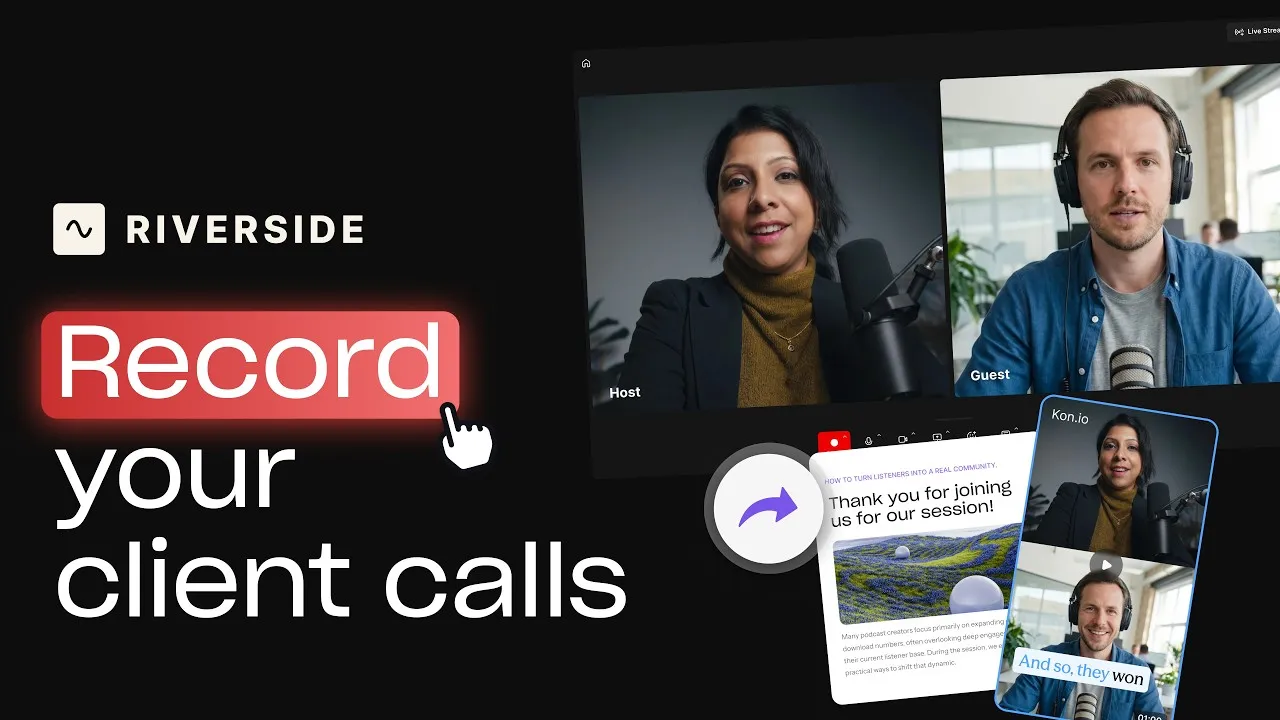
Record calls in Riverside, then use the transcript to create follow-ups, highlights, and insights.
Learn how to plan, set up, repurpose, and keep livestreams engaging.
A practical guide on how podcasters can leverage YouTube to grow.
Got a process that works for you? Get featured by submitting your step-by-step flow. Help other creators save time, learn new tricks and improve their productions.


.avif)